The Better Marketing Blog
Better tips, tools, and tactics for the AI era.
Better tips, tools, and tactics for the AI era.
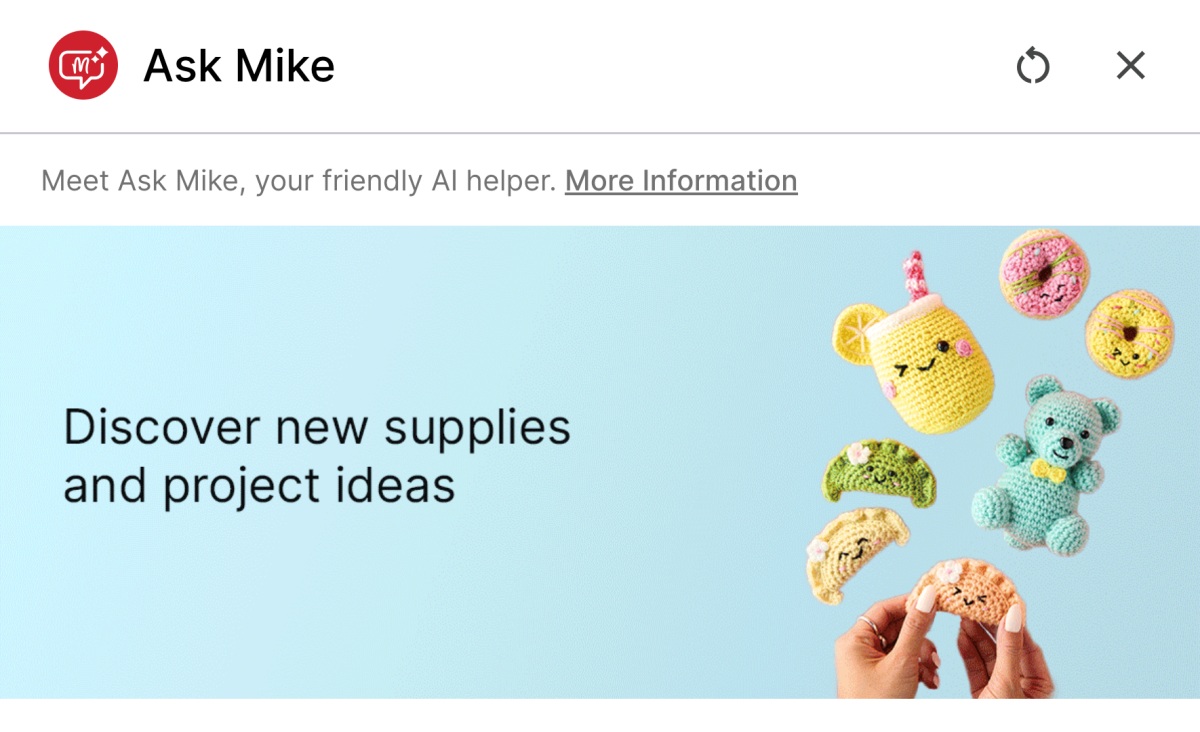
Michaels is onto something.
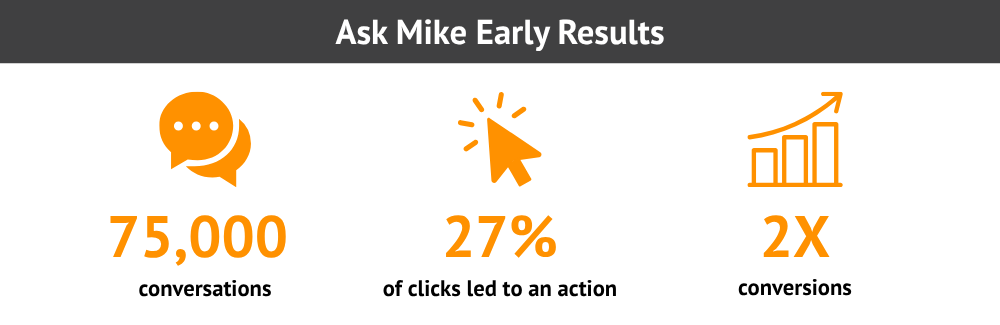
The arts and crafts supply retailer says visitors who use its “Ask Mike” AI assistant convert at more than twice the rate of visitors using traditional search.
The assistant handled 75,000 conversations during its early rollout, and 27% of those interactions led to a product click or add-to-cart action.
The numbers are early and company-reported. But the behavior shows that customers are expecting websites to do more than retrieve information. They want help choosing, troubleshooting, and completing the task in front of them.
And when companies give an AI experience to their customers, the customers are more likely to buy.
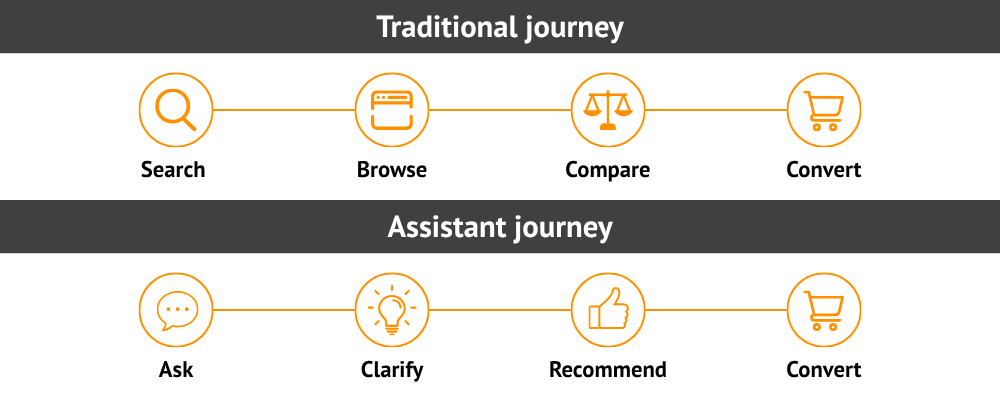
That shift changes the website journey from “search, browse, and compare” toward “ask, clarify, and recommend.”
Website search remains useful when customers know exactly what they need. AI assistants create a different kind of value for people who know the outcome they want but still need help reaching it.
A traditional search begins with a keyword.
A Michaels customer might search for “floral fabric,” “black balloons,” or “silver tablecloth.” Each query returns a separate set of products, leaving the customer to assemble the larger solution.
That works when the shopper already understands the project and its requirements. It creates friction when the shopper has only a goal, such as planning a space-themed birthday party on a specific budget.
Ask Mike lets customers describe the whole project. The assistant can ask about the occasion, colors, materials, budget, and other requirements before recommending a coordinated set of products.
For example, they might say, “I need a pattern and blue yarn for a baby blanket for less than $50.00.”
Michaels says they categorize products by project, and assistant users frequently add core supplies and finishing touches during the same session.
Search helps customers find an item, but conversation helps them think through the project.
The same need appears in B2B environments, although the stakes look different. A customer may be trying to solve a login problem, answer a client’s urgent question, or complete a time-sensitive task inside a complex software system.
They don’t need another list of links. They need help moving forward.
For decades, websites have required customers to learn the company’s language.
Visitors navigate departments, product categories, resource centers, and help-center taxonomies. They translate their needs into the terms the website recognizes. Sometimes they succeed. Sometimes they try six slightly different searches and quietly leave.
AI assistants reverse that relationship. Instead of forcing customers to think like the website, the website learns how customers describe their problems.
That gives us a useful way to describe the new journey.
The search box became standard because every website had information visitors needed to find. AI assistants will become standard because every website has customers trying to accomplish something.
The early evidence is promising, although companies are measuring different outcomes.
Here are some additional case studies that show promising early results.
Sticos, a Norwegian compliance-software provider, serves accounting and auditing professionals who depend on accurate, timely guidance. Many incoming questions are repetitive, including login issues, password problems, and basic product questions. Their urgency remains high because the professional asking often has a client waiting.
Sticos reports that its customer agent handles 41% of incoming support, beating the company’s 40% target. The assistant has achieved a 91% chat-deflection rate and a 75% chat-resolution rate.
With routine questions handled automatically, the human team has more room for proactive customer-success work and conversations that require judgment.
Bitfocus operates software used by organizations coordinating shelter, outreach, and housing services across the United States. Its users may need answers outside standard West Coast support hours while working directly with people who need immediate assistance.
The company’s AI customer agent provides round-the-clock help through its help center and in-product chat. Bitfocus reports that the assistant deflects 40% of incoming tickets, has reduced overall time-to-solve by 65%, and has generated roughly $300,000 in savings.
Ticket volume has also leveled off as the company’s customer portfolio has grown. Support teams feel that kind of scalability directly: customer growth no longer creates the same proportional increase in demand.
Michaels, Sticos, and Bitfocus are tracking different metrics, but each one points to the same underlying question: Did the customer get closer to a satisfying outcome?
For Michaels, that means finding the right collection of products and moving toward purchase. For Sticos, it means giving a professional a timely answer so they can return to client work. For Bitfocus, it means helping a frontline worker resolve a software issue without waiting overnight.
Conversation volume alone tells us very little. A thousand conversations that leave customers confused are hardly a triumph.
Choose the measure that best reflects the job you gave the assistant, then watch what happens after the conversation. Did the customer click, buy, resolve the issue, request a quote, or move to the next step?
The right measure depends on the job you gave the assistant.
At Media Shower, we’ve been building custom AI assistants for enterprise customers for several years, with thousands of customer conversations under our belt. (Learn more about our services here.)
We’ve found the strategic work lies in choosing the right task, supplying reliable knowledge, defining success, and improving performance after launch. Here are some of our best practices.
Start with a customer task that appears frequently, carries business value, and requires more guidance than a static page can provide.
Good starting points include:
Choose a task narrow enough that you can describe success in one sentence.
“Answer every question about our company” creates endless ambiguity.
“Help customers select the right service package and request a quote” gives the assistant a job.
Gather the information a skilled employee would need to do that job well.
That may include product data, pricing, policies, help articles, sales materials, approved support answers, brand guidelines, and examples of real customer questions. Set rules governing what the assistant can recommend, what it shouldn’t claim, and when a human should step in.
Sticos invested in structured knowledge articles and supplemental information before expanding its assistant. The team continues to create new articles and improve older ones based on performance data.
At Bitfocus, conversations the assistant struggled to answer exposed missing or outdated documentation. Each failure became a clue about what the company needed to explain more clearly.
That’s the uncomfortable gift of an AI assistant: it discovers how organized your company knowledge really is.
Choose a small group of outcome metrics before launch.
Depending on the task, these may include:
Match the metrics to the job you gave the assistant. Don’t judge a product recommender like a support agent, and don’t reward a support agent simply for keeping people in the chat.
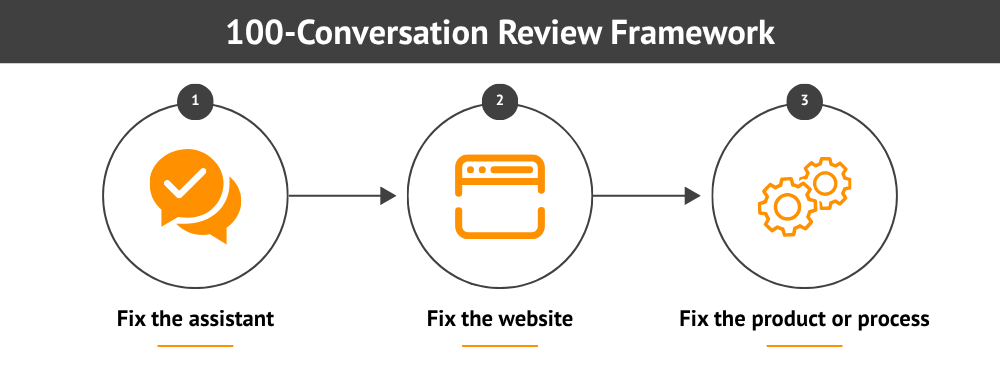
Create immediate value by manually reviewing the first 100 meaningful conversations.
Look for:
Then place each finding into one of three categories:
This turns the launch from a technology deployment into a customer-research program. It also gives you a concrete improvement backlog for the following week.
Soon, nearly any company will be able to place an AI assistant on its website. The novelty will disappear quickly.
The competitive advantage will come from how well the company organizes its knowledge, connects the assistant to the right systems, sets boundaries, and learns from performance.
Summarizing a page is easy. Understanding how the company’s products work, which policies apply, what information is current, and which next action makes sense for the customer is much harder.
That requires more than a chat interface. It requires structured information, clear ownership, reliable updates, approved answers, and rules for handling uncertainty.
Sticos trained its agent to account for overlapping product information and ask clarifying questions before selecting an answer. It also shaped the assistant’s language behavior for Norwegian, English, Danish, and Swedish users.
Bitfocus faces a different problem. Answers may vary by jurisdiction, so the assistant needs access to community-specific context. A generic response could be misleading even when it sounds polished.
A fluent answer is not necessarily a correct one. The more consequential the customer task, the more important the knowledge architecture becomes.
Humans decide what the assistant should know, what it should recommend, which answers need approval, and when it should escalate. They also decide what its performance reveals about the business.
A repeated unanswered pricing question may require a better knowledge article. It may also reveal that the pricing model itself is confusing.
A flood of product-comparison questions could lead to a new landing page, a sales enablement tool, or a simpler product lineup. The transcript identifies the pattern. A marketer still has to decide what to do about it.
Website assistants may initially look like support or IT projects, but their influence reaches much further.
They shape product discovery, brand voice, lead qualification, conversion, customer education, content strategy, and audience intelligence.
Lead the parts of the system your customers experience: voice, content, measurement, and insight. Bring in product, sales, support, legal, and technical teams to supply specialist knowledge and controls.
The strongest operating model will be cross-functional, but the customer experience needs a clear owner.
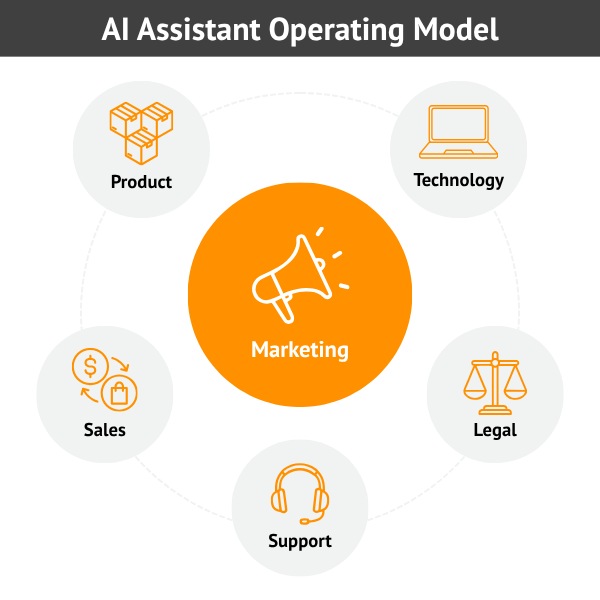
AI assistants come with a goldmine of information, in the form of customer insights. Real questions, asked by real people!
Those transcripts capture the customer’s own language at the moment they’re trying to choose, buy, understand, or solve something. Because assistant conversations are logged, you can see:
AI can sort thousands of interactions into recurring themes. From there, compare what you’re hearing with sales calls, support tickets, CRM notes, survey responses, emails, and live-chat records.
You’re no longer relying on what the company assumes customers care about. You’re working with the questions people ask when they’re actually trying to make a decision or solve a problem.
The winning brands are building AI assistants that not only understand their business, but that have a continual learning feedback loop: they get more useful as more customers use them.
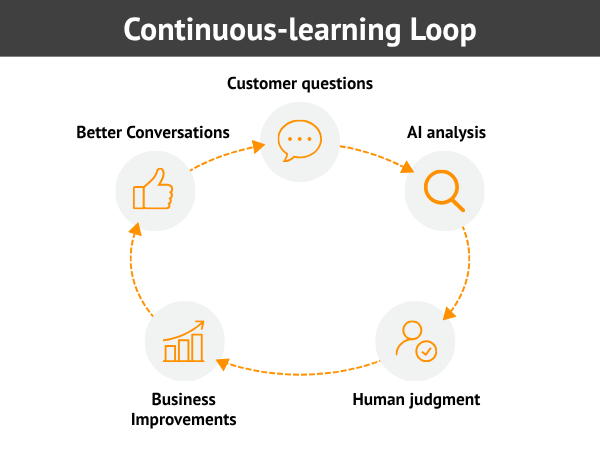
Once the assistant is live, the real work is keeping it useful. Search still has a role, some questions still need a human, and the knowledge behind the system has to stay current.
These practices will help you manage that work.
Keep a search box (if you have one) for customers who already know what they want. Someone looking for a specific product, page, or document may get there faster with a search box than a conversation.
Use the assistant where the customer needs help thinking through the problem in a conversational way.
Decide where the assistant’s job ends. Some questions need a person. Some actions need approval. Some topics shouldn’t be handled by the assistant at all. Create a decision tree on where to send specific high-value conversations (e.g., sales leads, support tickets).
Start with the questions where a wrong answer would do real damage. Make sure the assistant has guardrails to avoid triggering legal or compliance issues.
Give someone clear ownership of the knowledge base. Product information, pricing, policies, and approved answers all change, and outdated content has a way of accumulating quietly. Best practice is to review monthly.
Treat the assistant as an ongoing program rather than a finished deployment. It’s software, not a marketing campaign. Launch is only the initial version.
Every customer conversation leaves a trail. Read enough of them and you start seeing the places where customers hesitate, get confused, or can’t find the answer on your site.
For Media Shower clients, we review those conversations monthly to find the questions and objections that keep coming back. Our human analysts look at the underlying conversations, decide what matters, and recommend what should change.
Sometimes the fix belongs in the assistant. Sometimes it’s a better page on the website, or a fix in the product itself.
This is the true value of the AI assistant: not only can it answer today’s question, but the conversation can also improve tomorrow’s customer experience. (Learn more in How to Use AI to Listen to Your Customers.)
Media Shower creates AI assistants that boost revenue and slash expenses. Click here for a free trial.
A basic chatbot follows scripted paths or answers a limited set of questions. A modern AI assistant can understand open-ended requests, draw from company information, ask follow-up questions, and connect with tools that help complete a task.
Yes, particularly when customers need help with complex products, terminology, documentation, or workflows. Sticos and Bitfocus report strong results from assistants that help people resolve specialized questions and software issues. HubSpot reports the Sticos results here and the Bitfocus results here.
No. Every company should look at where people encounter unnecessary effort and decide whether an assistant would make the experience meaningfully easier.