The Better Marketing Blog
Better tips, tools, and tactics for the AI era.
Better tips, tools, and tactics for the AI era.

“Listen to your customer.”
It’s easy to say, hard to do. Now, AI is making it easier than ever to listen to your customer.
You have customer questions hiding inside sales calls, support tickets, surveys, customer emails, and chatbot transcripts.
Your customers are continually telling you what they want to understand, while most marketing teams sit in meetings trying to imagine what those customers care about.
In this article, we’ll show how AI-savvy marketing managers can get more of this customer data with a simple three-step cycle:
Repeated each month, the cycle makes your marketing efforts smarter, your marketing content more useful, and your marketing strategy more responsive to what customers actually want.
The first step is to gather customer conversations. Customer research is already happening throughout your organization; it’s stored in many different places under different names.
Marketing has AI assistant transcripts. Sales has call recordings and meeting notes. Support has tickets. Customer Success has onboarding questions. Your CRM may contain summaries, follow-up emails, objections, and requests.
Each source captures a different moment in the customer journey. Together, they show where people hesitate, what they misunderstand, and what they need before taking the next step.
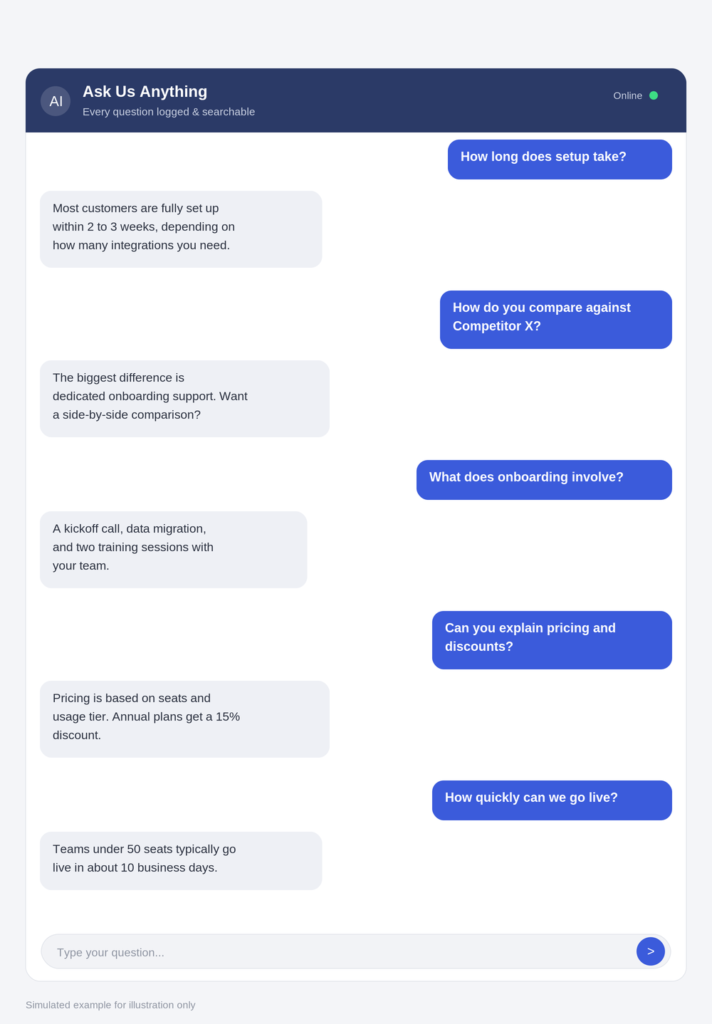
At Media Shower, we create customer-facing assistants that let prospects ask virtually any question about your company, products, or services.
We log every conversation, creating a growing record of the language customers use, the subjects they return to, and the answers they still can’t find.
If you have a similar AI chatbot installed, this is a goldmine for customer research. Typical questions we see on our clients’ websites:
Because every assistant conversation is logged, we have a complete record of every customer question.
For marketers used to thinking in campaigns or keywords, this is a real mind shift. Customers just ask the question in plain language, which is much more revealing.
AI assistant transcripts become more useful when enriched with other customer-facing channels:
Before loading these into AI, It is best practice to remove personally identifiable information; the goal is to understand collective behavior, not investigate individual customers.
To clean and organize the data:
Review these customer conversations and prepare them for analysis. Flag duplicate or irrelevant messages, remove personally identifiable information, and preserve the customer’s original wording wherever possible.
At the end of this step, you should have a clean body of conversations that represents real customer questions.
Next, ask AI to find the patterns.
It’s useful to read actual conversations, to get the gist — but reading hundreds of conversations is not scalable. This is where AI comes in.
To identify recurring questions, concerns, objections, and points of confusion:
Review these customer conversations and identify recurring questions, concerns, and objections. Group questions that express the same underlying need, estimate how often each theme appears, identify the likely customer intent, and include representative examples from the conversations.
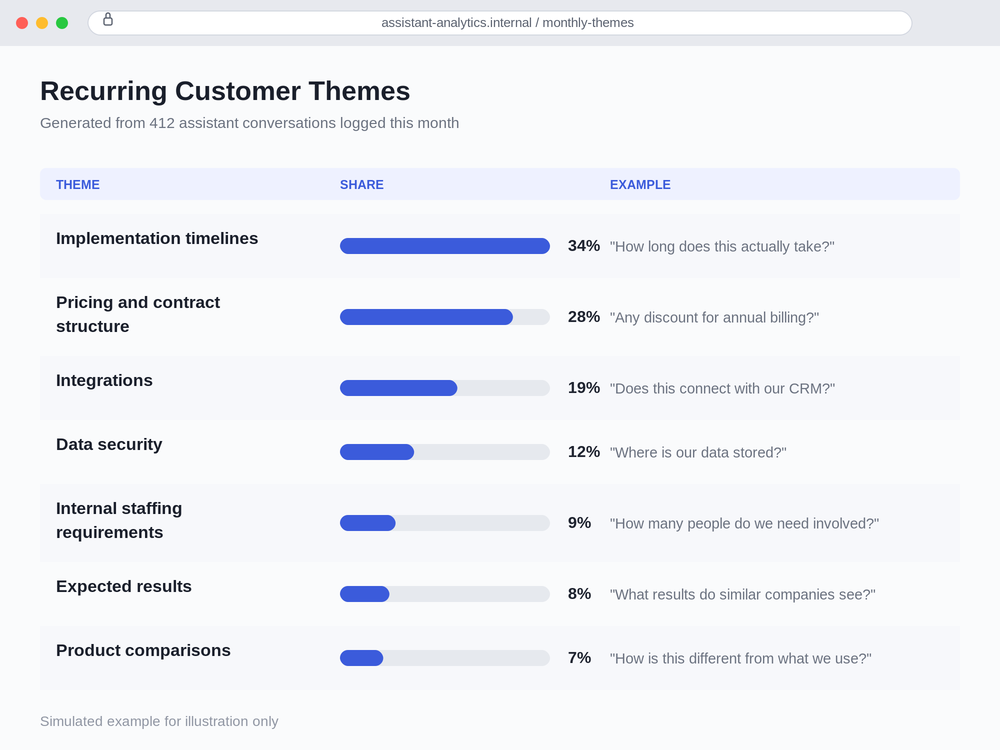
The output might identify themes such as:
Each month, Media Shower’s analyst team reviews the conversations generated by its customer-facing AI assistants. AI groups similar questions and surfaces recurring themes; analysts then inspect the underlying conversations to decide what topics matter most.
AI helps process the questions at scale. Human judgment helps narrow down the questions to the ones that matter.
Next, compare the questions against existing content.
Often, the answer is already somewhere on the website.
It may be incomplete. It may be buried in a long page. It may use internal terminology customers would never search for. It may answer the factual question while overlooking the concern behind it.
This is where human judgment matters most.
A customer question may call for:
Sometimes the best marketing move is to improve three sentences on a pricing page. Sometimes it’s to teach the assistant how to explain a complicated feature more clearly. Sometimes the question reveals enough uncertainty to support a full content series.
Look for the easiest way to get the user to the answer.
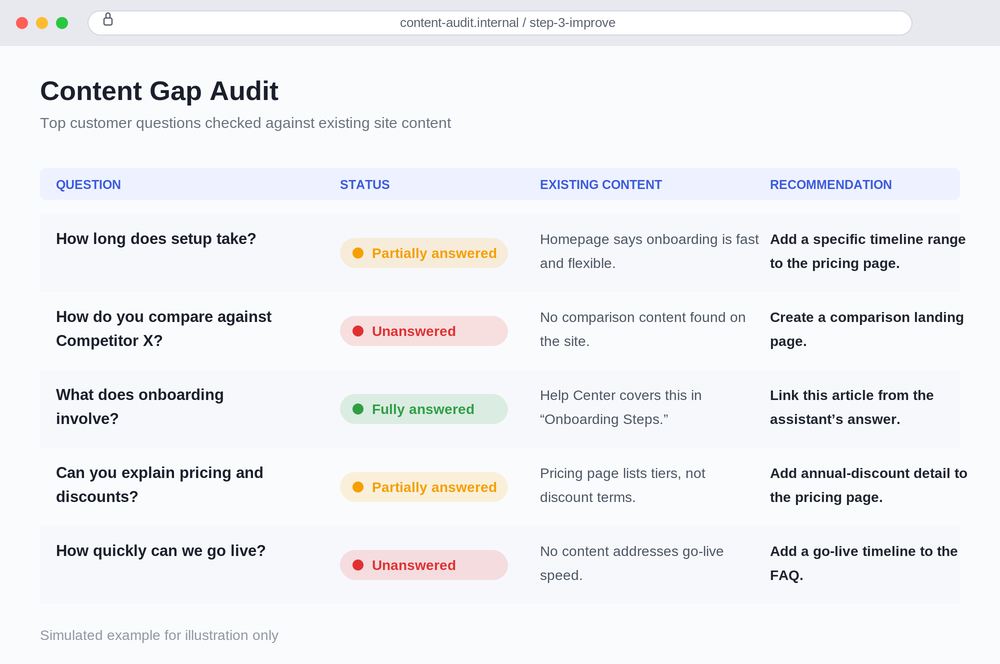
Suppose customers repeatedly ask how long implementation takes.
Your website may contain a sentence stating that onboarding is “fast and flexible.” Of course, the customer doesn’t know whether that means two days or two months.
AI tools like Claude Cowork can scrape your site and help locate relevant answers using a prompt like:
Browse our website as a potential customer and try to find answers to the list of questions below. Classify each question as fully answered, partially answered, or unanswered. Cite the relevant existing content and recommend the best improvement or destination for each answer.
As always, a person should review the list and make the final call.
This process gets so much better when you repeat it regularly!
Each month, Media Shower’s analysts review our clients’ AI assistant conversations, identify recurring themes, and use those findings to improve both their marketing and our recommendations.
The loop works like this:
Every conversation becomes part of the next improvement cycle.
That’s the real advantage of a customer-facing AI assistant: it’s not only an answering system; it’s also a listening system.
Media Shower’s AI marketing platform helps brands turn customer curiosity into competitive advantage.