Quick Summary
- The Rev. Al Sharpton makes history feel immediate by connecting public struggles to people, promises, losses, and choices audiences can experience now.
- His strongest speeches remove the comfort of historical distance and give listeners a role in what happens next.
- Familiar language gains power when a communicator gives it present stakes rather than simply repeating it.
- Historical meaning carries moral authority, so every connection between the past and present must be supported by the facts.
“Keep hope . . .” the Rev. Al Sharpton began. The audience at the 2026 Essence Festival knew what came next.
“Alive!” they shouted back.
The voice was Sharpton’s, but the words carried the voice of Jesse Jackson, his decades of civil rights work, and a relationship that began when Sharpton met Jackson as a 13-year-old preacher and later joined the youth work of Operation Breadbasket.
Jackson had died only months earlier, and the audience didn’t need the history explained. They could hear it in three words. Sharpton didn’t preserve “Keep Hope Alive” as a quotation from another era. He pulled it into the present and handed it to the room.
That move has shaped his public communication for more than five decades. Sharpton has spoken from pulpits, protest stages, convention halls, television studios, memorial services, and negotiating rooms. His delivery changes with the setting.
He can be combative, funny, mournful, theatrical, or pastoral, but the deeper pattern remains remarkably consistent: He brings history out of the past and makes it relevant today.
In Sharpton’s telling, the struggle still belongs to everyone in the room because it never stopped shaping the world they inherited.
Putting the Promise to the Test
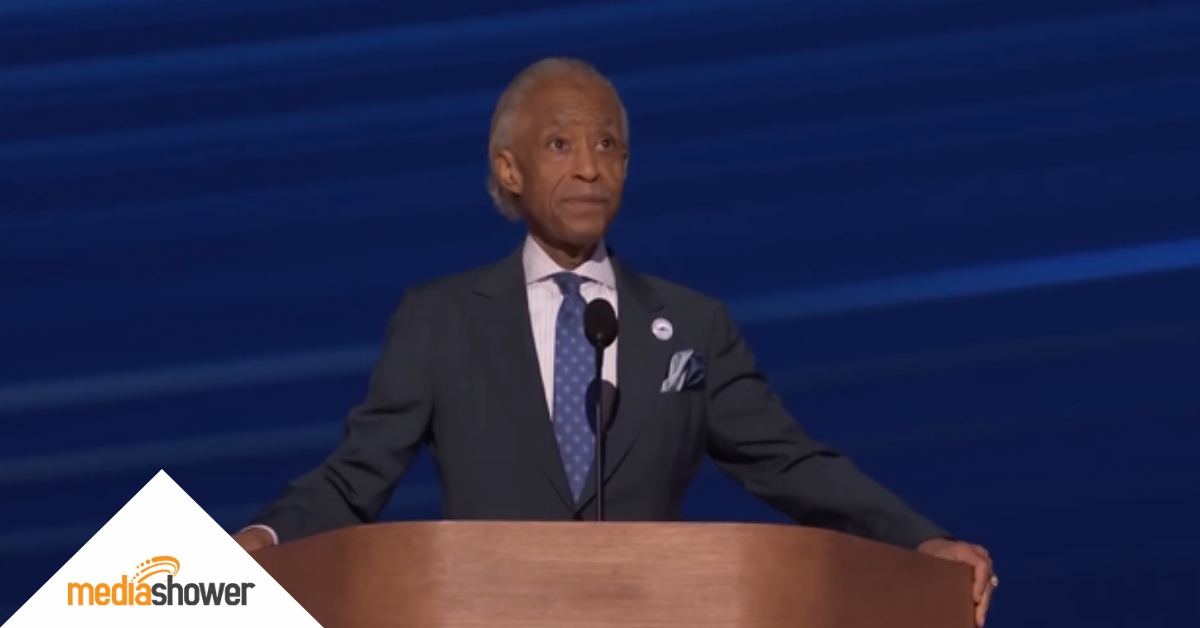
When Sharpton spoke at the 2004 Democratic National Convention, four months after ending his campaign for the Democratic presidential nomination, he could have used the appearance to celebrate the party or secure his place in a historic election cycle.
Instead, he built his speech around “the promise of America.” The phrase is so familiar that people can stop hearing it. Sharpton refused to let that happen.
“The promise of America,” he said, meant quality education for every child. Why were schools spending more on metal detectors than computers?
It meant healthcare for citizens. Why were seniors crossing into Canada to buy affordable medicine?
It included people who cleaned hospital rooms. Why weren’t they able to receive care in those same beds?
With each repetition, the promise gathered force. Sharpton used familiar national language as a standard and then checked the country’s work against it. The promise mattered because he refused to treat it as an accomplishment that belonged to the past. He made the present answer for how well the country had kept it.
Bringing the Personal Back Into View
Sharpton used the same instinct in a different emotional register at Michael Jackson’s memorial service in 2009.
Jackson’s death had produced a public spectacle almost as complicated as his life. The memorial carried the scale of a major entertainment production, complete with celebrity performances and global television coverage. Jackson’s children sat in the front row while millions of strangers debated who their father had been.
Sharpton turned toward them and said, “There wasn’t nothing strange about your daddy. It was strange what your daddy had to deal with.”
The line returned Jackson to the three children who had just lost their father. The celebrity, controversy, and spectacle briefly receded behind the person they knew. For a moment, the audience saw Jackson as his children did: as a father.
Sharpton had found the human being the public story had begun to obscure. By bringing that person back into view, he reminded the audience what was at stake.
Making One Life Carry a Larger Story
Sharpton’s most powerful example came during George Floyd’s memorial service in Minneapolis in June 2020.
Before Floyd’s name became inseparable from marches, murals, policy debates, and a worldwide racial justice movement, Sharpton began with the man his family knew. Floyd had a life before millions of people watched him die – a life that had been taken.
Then Sharpton widened the frame.
“What happened to Floyd,” he said, “happens every day in this country, in education, in health services, and in every area of American life.” For generations, he continued, Black Americans had been unable to become what they dreamed of becoming because America kept “a knee on our necks.”
At Floyd’s funeral in Houston five days later, Sharpton widened the circle again. He asked families of other Black people killed in acts of racial or police violence, including Trayvon Martin, Eric Garner, Botham Jean, Pamela Turner, Michael Brown, and Ahmaud Arbery, to stand.
Floyd’s death became part of a story that had already entered each of their homes.
“Get Your Knee Off Our Necks” became the name and rallying cry for the Commitment March in Washington on August 28, 2020. The words traveled because they carried both the intimacy of one life lost and the universality of a shared experience.
They gave grief somewhere to go.
Making History Stand in the Room
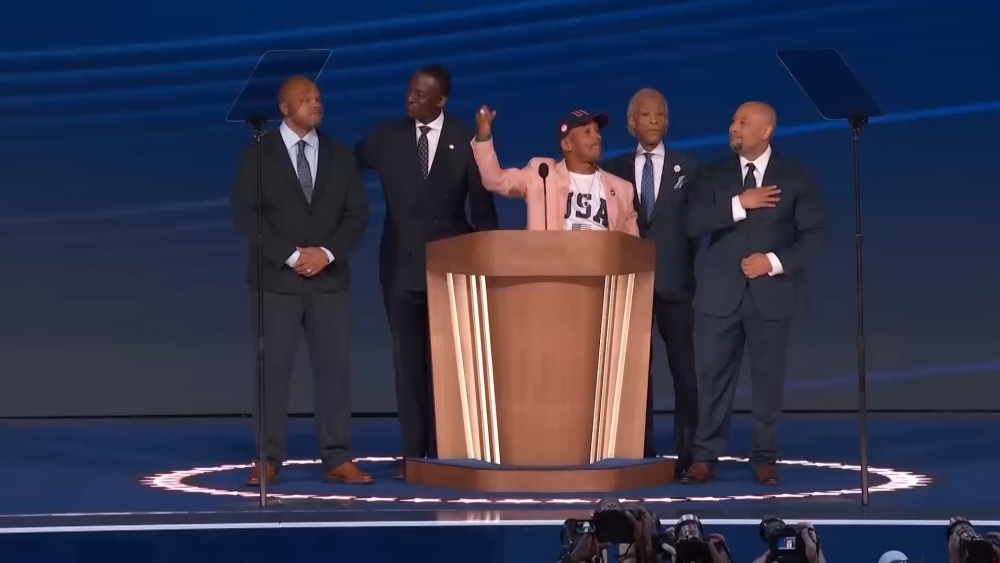
At the 2024 Democratic National Convention, Sharpton took that instinct one step further. Instead of using one life to illuminate a larger history, he brought the people who had lived that history before the audience.
Four members of the Exonerated Five, Yusef Salaam, Korey Wise, Raymond Santana, and Kevin Richardson, stood beside him. The fifth member, Antron McCray, was not present.
As teenagers, the five had been wrongfully convicted in the 1989 Central Park jogger case. Their convictions were vacated in 2002 after another man confessed and DNA evidence confirmed his account.
The men beside Sharpton were no longer photographs from an old news story. They were adults who had lost years of their lives, standing before a national audience.
Then Sharpton gave them the microphone. The history he introduced became testimony delivered by the people who had survived it.
He used his speech to establish the history, then stepped aside so the people inside that history could tell their stories and ask the country what it planned to do next.
The Work Isn’t Finished
By the time Sharpton reached the Essence Festival stage in 2026, “Keep Hope Alive” had echoed through nearly four decades of American public life. The phrase belonged unmistakably to Jesse Jackson, but it had never been Jackson’s alone.
He meant for it to be repeated. Sharpton understood that repeating the words was one way of continuing their work.
He began the phrase and left space for the audience to complete it. In that pause, Jackson’s words belonged to the people in the room. They were remembering a celebrated civil rights leader and accepting a place inside the story he had spent his life telling.
Sharpton’s greatest communication skill is giving the past a voice, then making the present answer.
Marketer’s Takeaways
- Use historical echoes to create recognition, then show why that history still matters now.
- Connect large ideas to a person, decision, promise, or loss the audience can experience.
- Leave room for audiences to complete, carry, or act on the message themselves.
- Treat brand heritage as an obligation to uphold rather than significance a company can borrow.
- Verify that the facts support every historical or cultural connection the message asks an audience to accept.
Media Shower’s AI marketing platform helps brands create content that carries their legacy forward. Click here for a free trial.