The Better Marketing Blog
Better tips, tools, and tactics for the AI era.
Better tips, tools, and tactics for the AI era.
Most AI tools answer questions. OpenClaw does your work.
It’s an AI app that takes action instead of just talking to you. You tell it what you need in plain English, and it takes over your computer, doing the work like an employee. Whatever the task — research, emails, calendar management, and anything else — it doesn’t wait to be prompted again; it runs the task through to completion.
Marketing teams are right to pay attention. The operational work and marketing tasks that eat entire afternoons are exactly what agentic AI was built for. Is OpenClaw impressive? Yes.
But the real question is whether it’s the right tool for a marketing team, and what it honestly takes to get value out of it.
OpenClaw is an open-source AI assistant built by Austrian developer Peter Steinberger. It runs on your machine or a server, connects to messaging platforms like Slack or Telegram, and takes instructions through natural language.
Tell it to monitor a competitor’s content and it scrapes, analyzes, and reports back on a schedule. Ask for a campaign performance summary and it pulls the data, structures it, and delivers it to you. It can literally work for days on a single project.
The architecture is model-agnostic. You can connect it to Claude, ChatGPT, Gemini, or a locally run model. A modular skills system lets you extend what it can do, and the developer community adds new capabilities constantly.

The enthusiasm is real. So is the audience driving it: developers and technically-minded power users who want an AI employee living in their chat apps, running tasks on a schedule, remembering everything across sessions.
Knowing who OpenClaw was built for is the starting point for figuring out whether it belongs in your stack.
OpenClaw is playing to an eager and receptive market. Agentic AI is the most talked-about technology in marketing right now.
The data shows both the opportunity and the gap between what organizations want and what they can realistically execute.
The pattern is consistent: high excitement, low readiness, and a skills gap that’s stalling real deployment. OpenClaw fits squarely inside that story. The technology works. Everything around it is the hard part.
AI tools are evolving quickly, and many marketers struggle to understand how different technologies fit together. One helpful way to think about the ecosystem is as a stack, with each layer serving a different purpose.
At the top of the stack are AI assistants, which most marketers already use for drafting content or brainstorming ideas.
Below that are automation tools that connect software platforms and automate predictable workflows such as sending leads to a CRM or posting content to social media.
The next layer introduces agent platforms like OpenClaw, which allow AI systems to plan and execute multi-step tasks such as gathering research, analyzing information, and generating reports.
Finally, there are managed AI marketing assistants, which turn all of these capabilities into tools designed for a specific organization’s workflow.
This is where many companies see the greatest value. Instead of experimenting with raw AI tools, they deploy purpose-built systems that automate real marketing work safely and reliably.
OpenClaw is powerful because it’s flexible. A reliable deployment means making infrastructure decisions, integrating with existing systems, and designing workflows carefully enough that they hold up in production.
That takes real engineering investment. For most marketing teams, either the resources aren’t there or the work pulls the wrong people away from higher-value priorities.
The cons worth understanding before you commit:
“Marketers must prepare by putting strong data governance in place, tracking customer journey changes weekly, and integrating agentic systems into martech stacks to enable secure, ethical personalization at scale.” – Emily Weiss, Senior Principal Researcher, Gartner Source: Gartner, Jan 2026
Take a common marketing request: automate weekly competitive intelligence reports. You might tell it: Monitor three competitors’ content, ad activity, and social presence, then deliver a structured summary for me every Monday morning.
OpenClaw can do it. Configure the agent with web scraping capabilities, define sources and analytical frameworks, connect email or Slack for delivery, set a recurring schedule. Done well, it saves real hours every week.
Getting to “done well” is the hard part.
It involves skill selection, prompt engineering, testing across different scenarios, and troubleshooting when something breaks. Something always breaks.
For a developer, that’s an interesting problem. For a marketing director running campaigns, it’s a tax on their actual work.
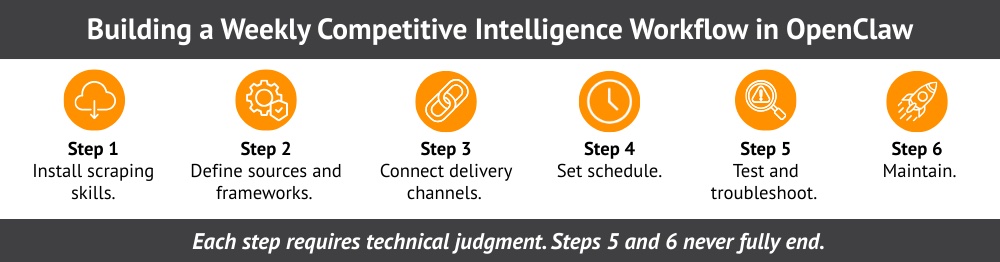
Here’s what’s involved in building a typical agentic workflow.
Step 1: Install scraping skills. Select and configure web scraping capabilities from ClawHub, OpenClaw’s skills marketplace.
Step 2: Define sources and frameworks. Set competitor URLs, choose analytical frameworks (SWOT, competitive matrix), and write context instructions about your brand’s priorities.
Step 3: Connect delivery channels. Integrate Gmail or Slack for automated report delivery.
Step 4: Set schedule. Configure a recurring cron job for weekly automated execution.
Step 5: Test and troubleshoot. Run through scenarios, fix edge cases, and refine prompts.
Step 6: Maintain. Monitor for breakage as competitor sites change and update skills as needed.
That same competitive intelligence project looks very different when humans and AI work together. A specialist team applies AI-powered deep research to the sources that matter most for your category, interprets what the data means for your positioning, and hands you analysis you can act on right away.
If your organization has dedicated technical resources and appetite for ongoing development work, OpenClaw is worth serious exploration. It’s capable, actively developed, and free. The community building skills and extensions are strong.
If your team’s job is marketing and your time is better spent on strategy, creative, and campaign execution than on AI infrastructure, the smarter path is working with a partner who has already done the hard work.
Building and maintaining an agentic system is real work, and for most marketing organizations, it sits outside the core competencies that make them good at what they do.
Top Barriers to Agentic AI Adoption
| Barrier | % of Organizations |
| Cybersecurity concerns | 35% |
| Data privacy | 30% |
| Lack of technical expertise | ~30% |
| Regulatory clarity | 21% |
| Connecting agents across workflows | 19% |
| Organizational change readiness | 17% |
Source: Landbase / Deloitte, 2025-2026
OpenClaw illustrates both the promise and the challenge of agentic AI. The technology is powerful, but turning that power into reliable marketing workflows requires technical expertise, governance planning, and ongoing maintenance.
Most marketing teams simply don’t have the development resources to build and maintain agent systems on their own. Their job is marketing strategy, creative work, and campaign execution, not AI infrastructure.
The opportunity is still very real. Agentic systems can automate research, reporting, and competitive monitoring in ways that save hours every week and surface insights faster than traditional workflows.
The key is implementation.
Media Shower builds Custom AI Marketing Assistants — trained on your brand, buyers, and strategy — so your team gets the power of agentic AI without the engineering burden.
You get:
Bottom line: Your job is marketing, not AI infrastructure. Ours is building the assistant that handles the rest.
You’ve read the guide. Now see what a Custom AI Marketing Assistant built for your team actually looks like. Book a free demo.