The Better Marketing Blog
Better tips, tools, and tactics for the AI era.
Better tips, tools, and tactics for the AI era.
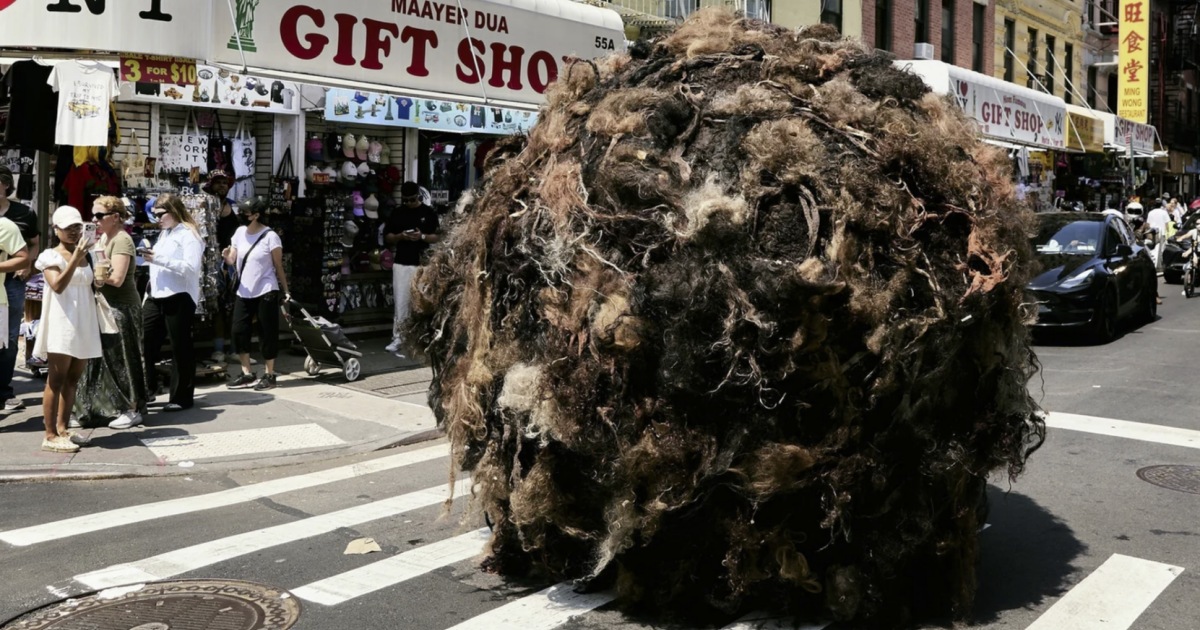
It was a stunt that looked so improbable – and so revolting – that people assumed it had been made by AI.
K18 and Uncommon Creative Studio sent a 10-foot hairball rolling through Manhattan, where pedestrians stopped, stared, filmed, and shared the thing before many of them knew what it was selling.
Confusion turned out to be the clever part: in a world where AI can generate any bizarre image on command, K18 created something people felt compelled to show was real.
Ask ChatGPT to generate an image of a 10-foot hairball rolling through Manhattan, and you can get it in seconds. This is slowly removing our ability to define what’s real and what’s AI.
Just as movie special effects or Pixar-level animations amazed us at one time, but are now just considered par for the course, it’s hard to build something that actually gets noticed IRL. (Especially with New Yorkers, who have seen it all.)
Which is why you have to admire the creative team behind the giant hairball.

The Tumblehair traveled through Midtown, the West Village, Chinatown, and the Seaport before reaching Gansevoort Plaza.
Along the way, it was filmed and uploaded on shaky phones by surprised New Yorkers, independently recording the same enormous clump of hair.
The beauty industry has spent an extraordinary amount of money teaching us what healthy hair should look like: glossy, flowing, and immaculately lit.
K18 put the stuff from your shower drain in the street.
A few strands of loose hair on a brush are normal, but more than usual should make you look twice. A clump of hair can trigger the unpleasant question that K18 wanted its audience to ask: Am I losing too much hair?
Now make that clump 10 feet tall.
The Tumblehair took a private, incremental concern and gave it public scale. You could walk past another serum ad without registering it. Walking past a giant hairball is harder.
Crucially, the grossness belonged to the category. K18 was promoting FutureIQ Hair Longevity Serum around premature hair aging and shedding.
Random disgust gets you a reaction, but relevant disgust can get you a product story.
Campaign coverage said the Tumblehair represented roughly 167 billion strands that New Yorkers could collectively retain by using FutureIQ.
Nobody can picture 167 billion hairs. People can picture a 10-foot hairball because, suddenly, it’s blocking traffic.
K18 took an abstract claim and gave it size, texture, movement, and a name. Then they gave the spectacle somewhere to go.
At Gansevoort Plaza, visitors could explore the product, take photos, participate in promotional activities, and receive personalized scalp analyses.
The hairball got the attention. The on-site demo created the opportunity for a conversation about someone’s actual hair.
AI can generate weirdness in abundance, which is what makes reality so scarce. If marketers take the time to build something unusual or attention-getting in broad daylight, it really can stand out – even in New York City.
The imperfect cameraphone footage from all those New Yorkers who shared the hair is “proof of reality”: it helps answer the question, Was this real or AI?
The obvious lesson is not to build something enormous and roll it through Manhattan. (Manhattan has enough problems.)
The useful lesson is to design experiential marketing for two audiences: the people who encounter the activation and the much larger group who will encounter evidence of it later.
Hair shedding gave K18 a physical problem to exaggerate. A precise product claim, customer anxiety, or recognizable behavior gives the creative team something similarly tangible to work with.
The object has to earn attention before the logo explains it. A stranger seeing the activation for three seconds should understand enough of the tension to become curious. Giant hairball: weird, gross, hair problem. The product can complete the story.
Size helps. So do movement, texture, participation, recognizable locations, and interactions with surroundings.
These choices make the activation more interesting in person, but they also make the resulting footage more persuasive online. Twenty strangers filming that object from twenty angles tell different stories.
The physical object is only half the media plan. Routes, viewing angles, stopping points, creator access, public interaction, and photo opportunities all affect how much independent material an activation produces. The goal is bigger than getting one perfect hero shot. You want evidence everywhere.
K18’s hairball appeared across lifestyle, beauty, advertising, and local-news coverage. Muse by Clios ranked it first among its ads of the week. One giant object became a street activation, a social object, and an earned-media asset.
K18 eventually brought the Tumblehair to an activation where people could move from curiosity to scalp analysis and product exploration. After earning attention, trial, consultation, demonstration, signup, or purchase leads to commercial potential.
Impressions tell only one part of the story for an activation like this. Track organic posts, earned-media placements, branded mentions, branded-search lift, foot traffic, samples, consultations, purchases, and downstream conversion. Separate what the brand distributed from what witnesses and publishers distributed independently.
The interesting metric may eventually be less “How many people saw our stunt?” and more “How much media did the real-world event cause other people to create?”
Media Shower’s AI marketing platform helps marketers make improbable ideas a reality. Click here for a free trial.
K18 created the Tumblehair to promote its FutureIQ Hair Longevity Serum and make the scale of hair shedding physically visible. The oversized object represented the number of strands the company claimed New Yorkers could collectively retain.
It was real. The approximately 10-foot-tall object was made from a mixture of human and synthetic hair. Some viewers initially assumed images and videos of it were AI-generated.
They can disrupt familiar surroundings, provoke an immediate emotional response, and give people something worth recording and retelling. They work best when the bizarre visual communicates a relevant customer problem or product benefit.
It depends on the objective. Physical activations usually reach fewer people directly, but they can generate eyewitness footage, earned media, social sharing, branded search, and customer interactions that digital distribution can amplify.
Track foot traffic, participation, samples, consultations, sales, organic posts, earned coverage, social reach, branded-search lift, sentiment, and downstream conversion. For K18, the available evidence includes earned coverage and a brand-reported 166 personalized scalp analyses, while complete reach, sales, and ROI figures haven’t been published.