SEO vs. AI Search: How Does Traffic Compare?
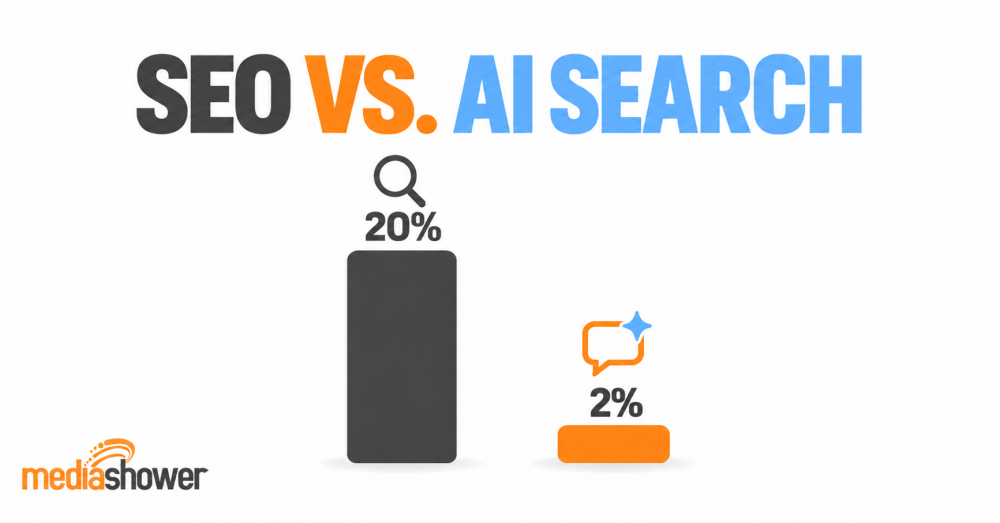
How much traffic are AI assistants like ChatGPT and Claude sending to B2B websites in 2027, and how does it stack up against organic search?
To find out, we analyzed Google Analytics 4 (GA4) data from seven B2B websites, including our own.
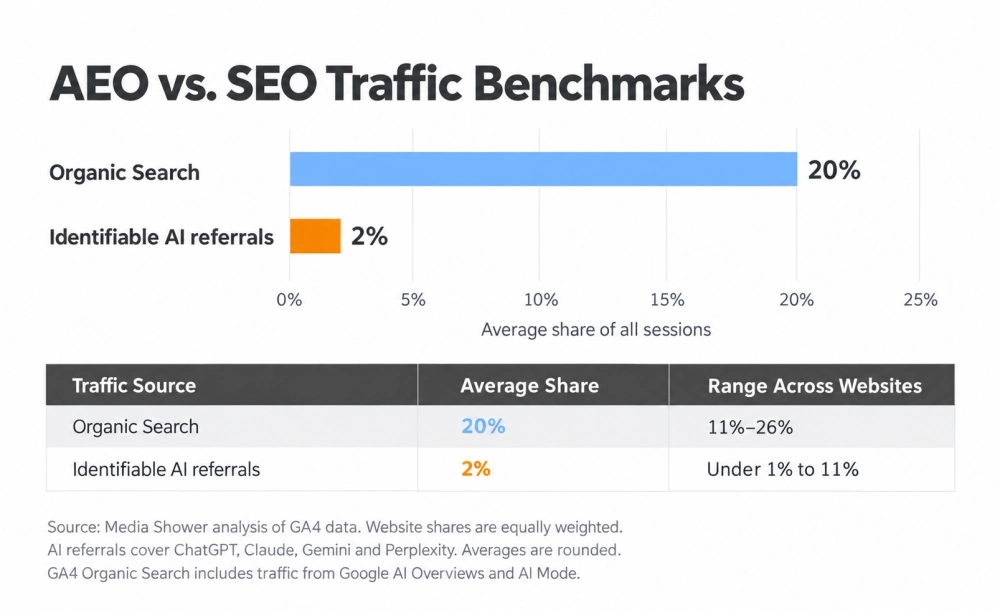
Here’s what we found: Organic Search accounted for an average of 20% of sessions, compared with 2% from AI-referred traffic.
Here’s how to use AI to compare traffic sources on your own site, benchmark against our averages, and track whether your brand shows up in the answers buyers see.
What You’ll Learn
- The practical difference between AEO and SEO
- Original AEO vs. SEO traffic benchmarks from seven B2B websites
- Why AI referral traffic understates total AI visibility
- How to track traffic, citations, brand accuracy, and qualified outcomes
- Copy-and-paste AI prompts for analyzing your own GA4 and visibility data
SEO vs. AI Search: What’s the Difference?
Search engine optimization (SEO) improves a website’s discoverability in search results. It determines where you show up in Google.
AI visibility, also confusingly known as Generative Answer Optimization (GEO) or Answer Engine Optimization (AEO), improves the likelihood that a brand, website, product, or idea appears accurately and prominently in AI-generated answers.
It may involve:
- Publishing clear, original, well-supported content
- Making important facts easy for machines to retrieve
- Demonstrating first-hand expertise
- Earning mentions from trusted third-party sources
- Maintaining consistent brand and product information
- Structuring pages so answer engines can identify entities and relationships
- Monitoring whether AI systems mention and describe the brand correctly
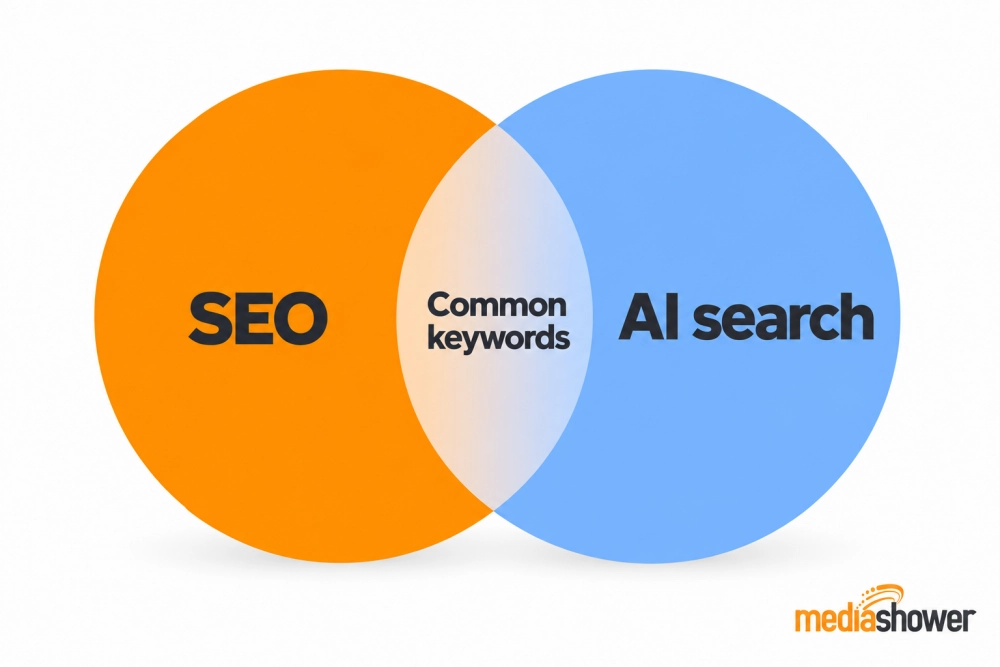
SEO and AI visibility overlap considerably. Search engines and answer engines both need accessible, useful, trustworthy information.
Google’s guidance for its generative search features states that established SEO practices remain foundational because those experiences draw on Google’s search index and ranking systems.
Improve one, and you usually improve the other.
But there’s a big difference: SEO generally results in clicks to your website. AI tools can give the user an answer so good, they don’t need to visit your website.
For marketers, that’s an enormous change.
SEO vs. AI Search Traffic: Our Benchmark
Across all websites that we surveyed, Organic Search supplied a larger share of sessions than AI-referred traffic.
How we calculated the benchmark
We reviewed GA4 sessions using:
- Identifiable AI referrals: Sessions whose exact source domain was chatgpt.com, claude.ai, gemini.google.com, or perplexity.ai, across all mediums
- Organic Search: Sessions GA4 classifies in its default Organic Search channel
- Equal weighting: We calculated each site’s traffic shares first, then averaged them across all seven sites, giving each site equal weight.
Equal weighting keeps the largest site from overwhelming the benchmark. Each property contributes one observation, whether it receives thousands or millions of sessions.
The definition also makes the benchmark reproducible. GA4 defines a source as the specific platform, site, app, or location that referred a session, while default channel groups use rules to organize those sources into broader categories.
One important qualification: GA4’s Organic Search classification includes traffic from Google’s AI Overviews and AI Mode. Therefore, these figures compare identifiable referrals from four standalone AI domains with GA4 Organic Search, rather than separating every AI-assisted search experience from conventional search.
We chose a small sample, so use our results as a starting point; you can measure your own using the AI prompt below.
Calculate Your AEO vs. SEO Traffic Shares
Upload A GA4 export for one complete month with session source, session medium, session default channel group, and sessions. Include the property’s total sessions for the same dates if the export omits them.
Act as a marketing analytics specialist. Analyze this GA4 export for [MONTH AND YEAR]. Use the property’s local dates and all sessions as the denominator.
Calculate sessions and session share for GA4’s Organic Search channel and, separately, for sessions whose exact source is chatgpt.com, claude.ai, gemini.google.com, or perplexity.ai, across all mediums.
Keep Google AI Overviews and AI Mode in Organic Search where GA4 classifies them. Label the four-domain group “Identifiable AI referrals.”
Return a comparison table with the date range, total sessions, and each group’s count and share. Document your filters and flag missing fields, incomplete rows, tracking problems, or small counts.
If I upload multiple properties, calculate each property’s shares first, then average the unrounded property shares equally. Round only the final averages to whole percentages.
AI Traffic is a Different Animal
Our research found that AI assistants send far less traffic to B2B websites than traditional search engines. But that doesn’t mean AI search is unimportant; it’s just a different animal.
When someone asks ChatGPT to recommend a product or compare vendors, they can learn about your company without ever clicking through to your website.
That’s why measuring AI search requires looking beyond website traffic. You also need to know whether AI assistants mention your company, recommend your products, and describe your business accurately.

Check Your AI Search Visibility
My company is [COMPANY], and our website is [URL]. We sell [PRODUCT] to [TARGET AUDIENCE].
Suggest five questions our potential customers might ask ChatGPT or other AI assistants when researching products like ours.
I’ll use these questions to check whether our company appears in AI-generated answers and how we compare with competitors.
[Note: The Media Shower platform measures all this for you.]
How to Measure SEO and AI Visibility Together
To understand how your company performs in traditional and AI search, track three things:
- Website traffic: Use Google Analytics 4 to measure how many visitors come from organic search versus AI assistants like ChatGPT, Claude, and Perplexity.
- AI visibility: Test the questions your buyers might ask AI assistants. Does your company appear in the answers? Is it recommended alongside competitors? Is the information accurate?
- Business results: Track which sources generate leads and customers. Ask new prospects how they heard about you, since AI may influence buying decisions without generating website visits.
Review these results monthly to see what’s changing and where to focus your efforts.
How Should You Balance SEO and AI Visibility?
Our research suggests that traditional SEO still deserves significant attention. Across the B2B websites we studied, organic search generated roughly ten times as much identifiable traffic as AI assistants.
But don’t ignore AI search. As more buyers use AI assistants to research products and compare vendors, your brand needs to appear in those conversations.
Our recommendation: Keep investing in SEO while building AI visibility into your regular marketing activities. Much of the work overlaps: publishing useful content, answering customer questions, and establishing your expertise helps with both.
How Media Shower Helps
Media Shower measures all this for you, then makes recommendations.
Our AI marketing platform helps you understand where your company appears in search and AI-generated answers, how you compare with competitors, and which opportunities are worth pursuing.
Instead of sorting through reports yourself, you get prioritized findings and recommendations that help your team decide what to do next.
Frequently Asked Questions About SEO vs. GEO
Do AI tools send less traffic than organic search?
Yes, in our sample of seven B2B websites. Identifiable AI referrals averaged 2% of sessions, compared with 20% for Organic Search. Organic Search led on all sites we measured. Your results may vary.
Is GEO replacing SEO?
GEO expands search strategy into AI-generated answers. Many foundational practices support both, including useful content, technical accessibility, clear brand information, and credible evidence. Google also says SEO practices remain relevant to visibility in its generative search features.
Does GA4 track traffic from ChatGPT and other AI assistants?
Yes. GA4’s AI Assistant channel groups identifiable traffic from ChatGPT and other assistants. Check exact session sources and document your reporting rules. An AI answer can influence a buyer even when it generates no referral session.
Does GA4 count Google AI Overviews as organic traffic or AI referrals?
GA4 includes non-ad clicks from Google AI Overviews and AI Mode within Organic Search. This means a GA4 Organic Search total may contain visits originating from generative search experiences.
How often should we review GEO and SEO performance?
Review traffic and visibility monthly, investigate significant changes as they occur, and evaluate strategic investment over several months. Longer windows reduce the risk of drawing conclusions from low-volume B2B conversion data.
See What Your Marketing Is Missing
Start your free Media Shower trial and get personalized insights on your SEO, competitors, AI visibility, and what to do next.