The Better Marketing Blog
Better tips, tools, and tactics for the AI era.
Better tips, tools, and tactics for the AI era.

Marketing teams spend hours per week on tasks that follow the same patterns: writing social posts, drafting emails, formatting reports. Custom GPTs can handle these tasks in seconds. They’re trained on your brand and a specific task and are ready to work around the clock.
In this guide, we’ll share what we’ve learned from our experience building custom GPTs for clients. We’ll show you how they work, helping you free up hours per month that your team can redirect toward strategy, creative development, and high-impact campaigns.
Custom GPTs are specialized AI assistants built for specific marketing tasks. Unlike general-purpose AI tools, these assistants are trained on your brand voice and style guidelines.
Think of them as expert team members who handle your highest-volume work. They know your hashtag strategy, your email tone, and your report format. They work 24/7 with no breaks and no waiting for availability.
The difference between a custom GPT and regular ChatGPT? A custom GPT knows your brand inside and out. It writes like your team writes and follows the patterns that have worked for you in the past.
Let’s look at where the hours actually go:
That’s 38-50 hours per week your team can easily spend on work that follows predictable patterns—work that a custom GPT can handle in minutes.
Sources: HubSpot State of Marketing Report 2024, CoSchedule Marketing Time Management Report
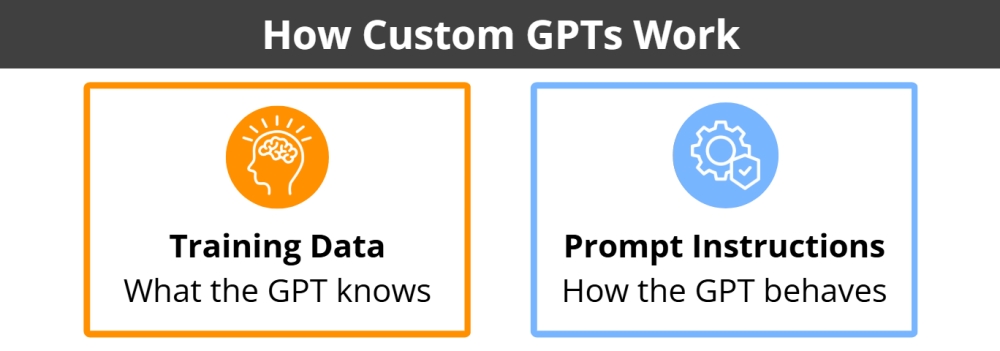
A custom GPT works because it combines two things that most AI tools keep separate: training data and behavioral instructions. Together, they shape how the system sounds, what it knows, and how it operates inside your workflow.
Training data gives the GPT context. This is where you show it how your team actually works.
That data usually includes:
By learning from real examples, the GPT picks up patterns that would be difficult to explain manually. Over time, it applies those patterns to new tasks without needing repeated correction.
The prompt defines behavior. It tells the GPT how to act when it uses the training data.
These instructions typically cover:
The training data teaches the GPT what your brand is. The prompt shows it how to apply what it knows in a consistent way.
With clear instructions and quality examples, you get drafts that are 80-90% ready to publish.
Let’s look at three high-impact custom GPTs that eliminate the most time-consuming marketing tasks. These examples show what’s possible when you train specialized assistants on your specific workflows and brand voice.
The drain: Writing multiple platform-specific social posts every week, each optimized for different audiences and formats.
The custom GPT solution: A specialized assistant trained on your successful posts, brand voice, hashtag strategy, and audience preferences.
How you would use it: “Create 5 LinkedIn posts announcing our new analytics dashboard feature.”
The drain: Creating promotional emails, welcome sequences, and newsletters that match your brand voice and drive conversions.
The custom GPT solution: An assistant trained on your best-performing emails, subject line formulas, and conversion patterns.
How you would use it: “Draft a product launch email for our new project management integration.”
The drain: Turning raw analytics into readable executive reports that highlight wins, identify opportunities, and tell a coherent story.
The custom GPT solution: An assistant that structures insights consistently, pulls key metrics, and formats narratives the way leadership expects.
How you would use it: “Summarize December’s campaign performance for the leadership team.”
Reports that required careful data analysis and narrative crafting now generate in minutes.

Cascade Digital’s marketing manager was spending 10+ hours every month creating performance reports for leadership. The process involved pulling data from Google Analytics, ad platforms, email software, and the CRM.
She then had to organize everything into a narrative that highlighted wins, explained challenges, and recommended next steps.
After deploying a custom GPT trained on six months of past reports, she copies relevant data into the assistant with a simple prompt: “Summarize December’s campaign performance for the leadership team.”
Here’s a sample response.
Campaign Performance Summary
Overview: December delivered strong performance across paid and organic channels, and email campaigns significantly outperformed projections.
Key Wins
Challenges
January Priorities
Budget Status: 94% of Q4 budget utilized, finishing $8,400 under projection while exceeding lead targets by 23%.
This report took 8 minutes to generate and review. Without the custom GPT, creating this same summary—pulling data from multiple platforms, identifying patterns, framing challenges constructively, and formatting everything in the company’s standard structure—might have reasonably taken 3 hours.
That’s 2 hours and 52 minutes reclaimed from a single task. Multiply that across weekly social posts, daily email drafts, and monthly reports, and you’re looking at 50-100+ hours saved every month.
While building custom GPTs requires technical understanding, here’s what the process looks like at a high level.
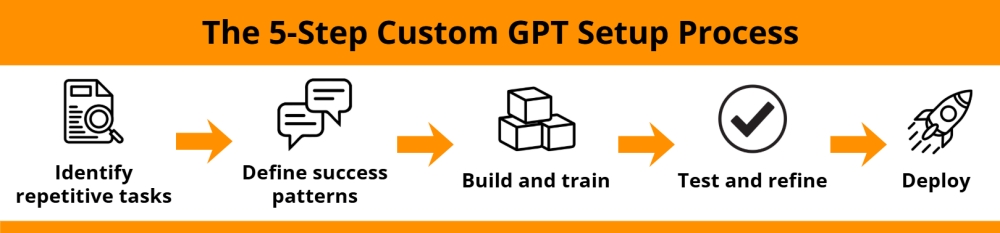
Custom GPTs deliver serious time savings, but building them requires understanding both AI capabilities and marketing workflows.
We create AI assistants for marketing teams and handle the technical setup and training, so you can start reducing repetitive work without taking on another system to manage.
We build custom GPTs around your brand voice and your highest-volume tasks, then deploy them either as standalone tools or inside the Media Shower platform. Within the platform, teams can access assistants in one place, share them across roles, refine outputs over time, and apply consistent standards across campaigns without rebuilding context.

Media Shower is the leader in building custom GPTs for marketers. Click here for a free trial.