How to Do a Content Gap Analysis Using AI (With Example)


A content gap analysis shows you what SEO or AEO keywords your competitors own that your website does not, or where your existing content could do a better job.
Done well, a good content gap analysis helps you find the content opportunities most worth pursuing.
In this guide, we’ll show you how to use AI to analyze competitor keywords, compare them with your existing content, prioritize the best opportunities, and turn them into a practical content plan.
We’ll use a fictional payroll software company to show the process step by step.
What You’ll Learn
- How to choose search competitors and scope the comparison
- How to distinguish a missing topic from a page that needs work
- How to group keyword variations by the task a reader wants to complete
- How to use the real-world example to turn the strongest gaps into article briefs
Step 1: Choose the Right Search Competitors
Elena, a marketing manager for a B2B payroll software company, is looking to create a content gap analysis, and starts by putting together a list of competitors.
First, Elena asks her sales team to list their top competitors. She also does a little Googling to see who shows up in top searches, and asks her AI tool to recommend additional competitors.
Find Your SEO/GEO/AEO Competitors
Upload Your website URL and a brief description of your business and target customers.
Identify 5 websites that compete with us in Google search results for topics our customers care about.
Include both direct business competitors and other websites that rank for relevant searches, such as industry publications or educational resources.
For each competitor, explain:
- Why they’re relevant to our audience
- What topics or keywords they compete with us for
- Why we should include them in our content gap analysis
Prioritize websites that consistently rank for topics relevant to our business, rather than simply choosing our biggest business competitors.
(Our competitor keyword analysis article walks through building and validating a competitor set.)

Step 2: Find the Keywords Your Competitors Rank For
Now that you’ve identified your competitors, the next step is to find out which keywords bring visitors to their websites—but not yours.
You can do this with an SEO tool like Ahrefs Content Gap or Semrush Keyword Gap:
- Enter your website and the competitor websites you identified in Step 1.
- Look for keywords where competitors rank but your website doesn’t.
- Export the results as a CSV file that you can upload to an AI tool.
Our example: Elena compares her payroll software company’s website with three competitors. Her first report contains 18,000 keywords! She filters out competitor brand names and unrelated topics, narrowing the list to 1,200 relevant keywords.
That’s still far too many to review manually. This is where AI becomes useful.
Step 3: Use AI to Find Your Content Gaps
Upload your keyword export to ChatGPT, Claude, or another AI tool. Rather than reviewing hundreds of keywords individually, you can ask AI to group them into topics and identify which ones are worth investigating.
For example, “payroll year-end checklist” and “year-end payroll checklist” are essentially the same topic. You probably don’t need two separate articles.
You also want to compare these topics against your existing website. Some will require new articles; others may be better addressed by updating pages you’ve already published.
Find the Gaps in Our Website Content
Upload Your competitor keyword export and a list of your existing website pages, including titles and URLs.
Analyze the keywords our competitors rank for and group similar keywords into topics.
For each topic:
- Identify the main keyword and estimated monthly search volume.
- Explain what someone searching for this topic wants to know.
- Check whether we already have a page covering it.
- Recommend whether we should create a new page, improve an existing page, or skip the topic.
Present the results in a table, with one row per topic. Prioritize topics relevant to our business and customers.
Use the supplied data, flagging anything that needs manual verification.
Step 4: Cluster Keywords Into Meaningful Topics
“Payroll year-end checklist” and “year-end payroll checklist” point to the same task. “How to close payroll for the year” might belong with them if the same checklist would answer it well.
Elena asks AI to suggest groups, then checks the live results for ambiguous pairs. “Payroll audit checklist” and “payroll compliance checklist” may need separate pages if readers are preparing for different tasks.
Keep one row per reader task in your working sheet. Give each group a representative query and use the supporting terms to see what questions the page should answer. If you sum estimates for closely related terms, label the total as directional because multiple queries can come from the same person.
Group keyword gaps by reader task
Upload The cleaned keyword export, your customer personas, and any current ranking URLs
Group terms that one page could satisfy. For each group, return the reader’s task, a representative query, supporting queries, and a likely page format. Classify the dominant intent as informational, commercial investigation, transactional, or navigational.
For groups with an existing URL, identify what that page already helps readers do and what’s still missing. When you have comparable, deduplicated volume estimates, label any total as directional.
Flag ambiguous groups for live search review and say what would justify giving them separate pages.
Our example: Elena discovers that her competitors have useful resources about switching payroll providers, planning payroll implementation, and year-end payroll checklists.
Her own website has a payroll compliance calendar, but it’s outdated. AI recommends updating that page rather than creating a new one.
Elena now has a manageable list of content opportunities instead of 1,200 disconnected keywords.
Step 5: Prioritize Your Best Content Opportunities
Not every content gap is worth filling.
A keyword might have thousands of monthly searches but attract the wrong audience. Another might have relatively little search traffic but reach exactly the customers you’re trying to win.
In our three decades of SEO work, we’ve found that the best content gap opportunities are the ones where you can provide something genuinely useful to potential customers.

To prioritize your opportunities, consider five factors:
Multiply each score by its weight and add the results. The weighted total ranges from 7 to 35. Use it to sort the shortlist, then review the evidence and effort behind any close calls. Google’s helpful content guidance is a useful check on originality.
Prioritize Our Content Opportunities
Upload Your list of content gaps from Step 3.
Score each content opportunity from 1 to 5 for audience relevance, business value, search opportunity, ranking feasibility, and originality.
Give audience relevance and business value twice the weight of the other factors.
Return a table showing each topic, its total score out of 35, and your recommended next action.
Explain why the highest-priority topics are worth pursuing. Flag scores that need additional research.
Content Gap Analysis Example
Here’s what Elena’s prioritized list looks like.
Notice that the payroll software comparison topic has the highest search volume, but it doesn’t rank first on Elena’s priority list.
The implementation guide ranks higher because it’s highly relevant to potential customers, less competitive, and gives the company an opportunity to share its own expertise.
Step 6: Turn Your Content Gaps Into Article Ideas
You’ve identified your best opportunities. Now it’s time to turn them into actual content.
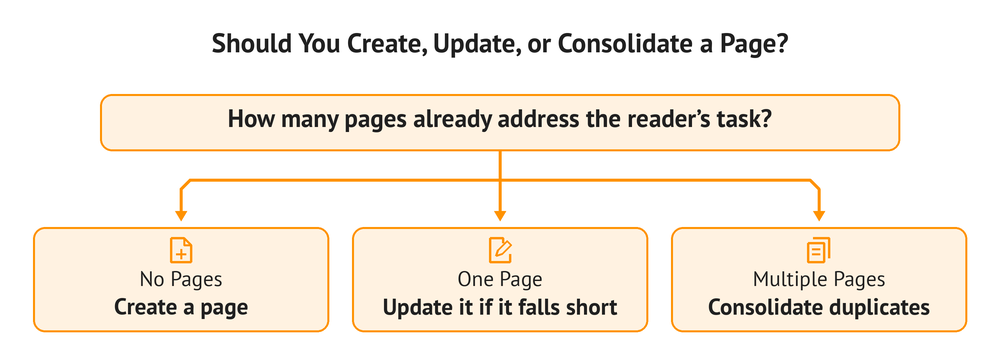
For each topic, decide whether to create a new article, improve an existing one, or combine overlapping pages.
Then use AI to create an article brief that your writers can follow.
Turn Content Gaps Into Article Briefs
Upload Your prioritized content opportunities, your website URL, and a brief description of your target audience.
Create article briefs for our five highest-priority opportunities. For each article, include:
- A suggested SEO-friendly title
- Primary and secondary keywords
- The audience and what they want to learn
- A recommended outline with H2 and H3 headings
- Suggestions for making the article more useful or original
- Relevant existing pages we should update or link to
If an existing page can satisfy the topic, recommend updating it rather than creating a competing article.
Our example: Elena starts with an article called “Payroll Implementation Plan: Timeline, Owners, and Template.”
Instead of producing another generic overview of payroll software, her team creates a practical implementation guide based on its experience helping customers switch systems.
The article includes a rollout timeline, a checklist of responsibilities, and a downloadable planning template.
That’s the real value of a content gap analysis: not simply finding keywords you don’t rank for, but discovering opportunities to create content your customers genuinely need.
(For a page already within reach of Google’s first page, use our guide to getting on Google Page 1 to plan and measure the update.)
How Media Shower Streamlines Content Gap Analysis
The Media Shower platform basically does all this for you.
It starts with understanding your marketing – including your company and target customer – then adds competitor and SEO data to make content gap recommendations.
As your team executes the recommendations, the platform remembers what happened so it can get even smarter for the next round of content gap analysis.
Frequently Asked Questions
How often should you run an SEO content gap analysis?
Start with a quarterly review for an active content program and revisit the full analysis when your audience, product, or competitors change. If search results move quickly in your market, monitor your highest-priority topics monthly.
What’s the difference between content gap analysis and keyword research?
Keyword research maps the searches your audience makes. A content gap analysis compares that demand with what other sites cover and what you already publish, so you can decide where a new or improved page would help.
Can you do a content gap analysis without a paid SEO tool?
Yes. Start with Search Console and a content inventory, then sample live results for questions your customers ask. Record the pages and formats that show up. Treat the findings as directional because you’re working with a smaller sample.
How do I know whether to create or update a page?
Create a page when none of your existing URLs can satisfy the reader’s task. Update a page when it already serves the same task but needs more depth, a better format, or fresher information.
How do you know if filling a content gap worked?
Pick a measure that fits the page’s job. Check Search Console for impressions and clicks from the target queries. If the page is meant to help buyers take a next step, track that action too, such as template downloads.
See What Your Marketing Is Missing
Start your free Media Shower trial and get personalized insights on your SEO, competitors, AI visibility, and what to do next.