The Better Marketing Blog
Better tips, tools, and tactics for the AI era.
Better tips, tools, and tactics for the AI era.
Black Friday used to be a retail holiday; now it’s an annual referendum on how imaginative a brand can be under peak pressure. The ideas that break through prove you don’t have to be the loudest or the most discounted. Winning brands treat Black Friday as a cultural stage rather than a sales event.
These 10 campaigns offer tactical lessons about what works with Black Friday campaigns and what marketers can borrow from them today.
Liquid Death sidesteps Black Friday entirely, shifting to a mid-November event they call Red Wednesday. Instead of fighting for attention during the year’s loudest shopping weekend, they build their own stage and invite fans to show up early.
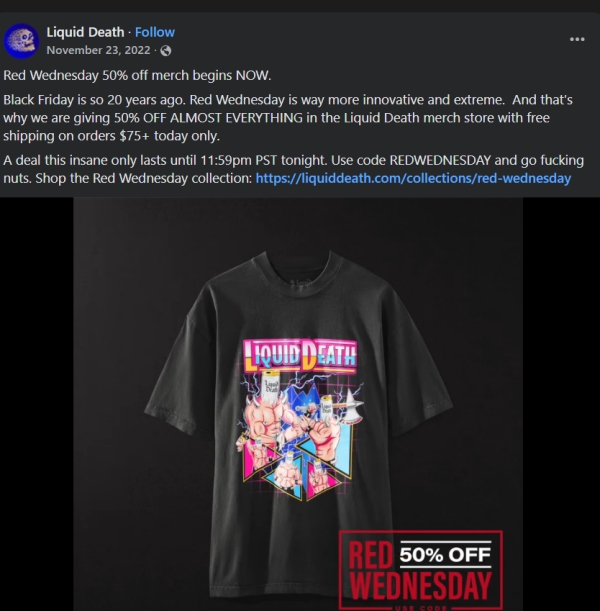
Red Wednesday turns the traditional retail calendar inside out. While most brands fight through sky-high CPMs and a wall of promotional noise, Liquid Death runs its biggest sale before the rush.
The company drops heavy discounts on its fast-growing merch line (shirts, hoodies, skate decks, and the brand’s now-iconic accessories) but avoids the digital pile-up that makes Black Friday so expensive and so forgettable.
The tone is what fans expect: macabre humor, metal-album visuals, and a wink at the absurdity of “shopping holidays.”
If you can’t outspend the competition, outmaneuver them. Creating a unique, branded time slot allows you to control the narrative and own the conversation early.
In 2015, REI shut down all stores, paid every employee to spend the day outside, and asked customers to do the same. The message was simple: Black Friday could be reimagined.
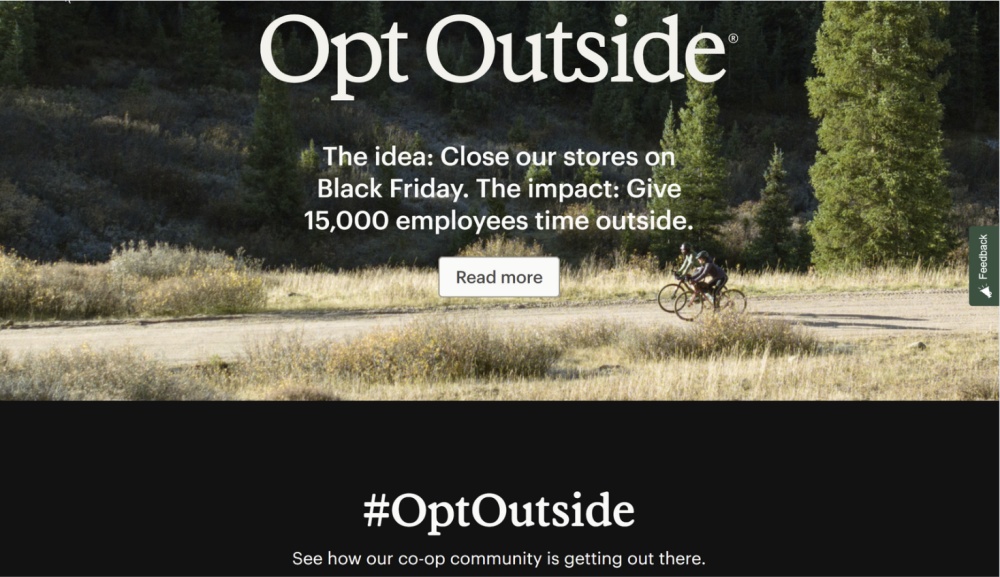
Since 2015, REI continues to close all stores on Black Friday. The idea promotes the #OptOutside hashtag, encouraging customers to skip shopping and enjoy nature instead.
For 2025, the focus continues to be on the legacy of purpose-driven business and its commitment to a permanent culture shift.
Countercultural positioning creates memorable differentiation that’s true to the brand. Your corporate policy can be your best advertisement.
Most beauty brands sharpen their elbows for Black Friday, but Deciem takes a breath. Their annual Slowvember campaign replaces urgency with intention, offering a steady 23% discount throughout November … and shutting down all shopping on Black Friday itself.
It’s a gentle rebellion that fits a company built on transparency, science, and the idea that skincare shouldn’t feel like a sprint.
Instead of flash sales and countdown clocks, Deciem stretches one thoughtful discount across the entire month. On Black Friday, they close their stores and online checkout entirely, reminding customers to research products, understand ingredients, and buy only what makes sense for their skin.
The message is clear: The brand refuses to feed the frenzy. They’d rather give customers time than shove them through a funnel. For a company rooted in measured formulation and clinical clarity, the approach feels authentic down to the bone.
Counter-programming against consumer anxiety can be a powerful differentiator. Transparency and measured value drive conversion better than short-term scarcity tactics.
Cards Against Humanity treats Black Friday like a comedy stage. Every year, the brand rolls out a stunt designed to mock consumerism itself: selling “nothing” for $5, raising prices instead of lowering them, even digging a giant, pointless hole funded by donations.
As this year’s campaign brews, the brand hasn’t revealed a thing. The mystery is the event. Fans wait, speculate, and refresh feeds, anticipating the next absurd twist.
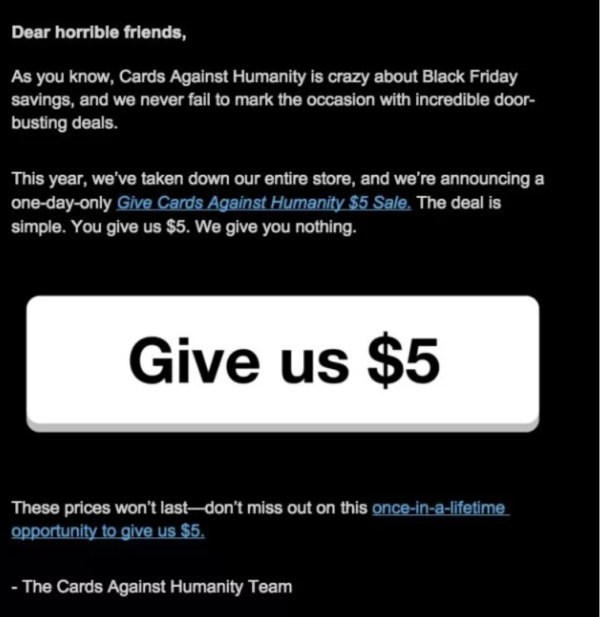
The company has spent years building a holiday tradition out of disruption. Instead of discounts or doorbusters, Cards Against Humanity drops an anti-promotion that functions as performance art.
Their audience expects satire, not savings, and the brand leans into that expectation by keeping each year’s stunt secret until the moment it lands. Even in silence, they dominate the conversation.
Alignment with brand personality. The stunts reinforce Cards Against Humanity’s identity as a counterculture brand that skewers norms instead of following them.
Lean into your brand personality fearlessly. Humor, self-awareness, and strategic absurdity can generate immense earned media and strengthen community loyalty, often replacing traditional ad spend.
Walmart tapped into one of the strongest forces in pop culture: collective nostalgia. The retailer reunited the original Mean Girls cast for a series of fast-paced Black Friday spots that revisited iconic scenes with a playful twist.
Each moment delivered the familiarity fans love, layered with winks at the original script. Carefully placed deals felt like part of the joke rather than product placement.
The multi-video rollout lived across YouTube, TikTok, Instagram, and Walmart’s owned channels. Instead of a single hero spot, Walmart approached the reunion as serialized entertainment, dropping clips that echoed the movie’s best-known lines and dynamics.
Viewers got a dose of early-2000s nostalgia wrapped in a modern retail message.
The result felt less like an advertisement and more like a cultural event. Fans shared, quoted, and dissected each spot the way they would a movie trailer.
The campaign worked so well that for the 2024 holiday season, Walmart repeated the strategy with a charming “Gilmore Girls” commercial.
Pop culture partnerships work when execution respects the source material and is entertaining enough to be shared. Entertainment value increases ad view-through rates and brand perception.
Most retailers sprint toward peak consumption. IKEA took a different route. Their Green Friday initiative invites customers to return used IKEA furniture in exchange for store credit.
The company refurbishes and resells the items through second-hand sections, turning a traditionally high-waste shopping moment into something circular, practical, and refreshingly grounded.
Green Friday encourages customers to buy less and extend the lifespan of products they already own. The program aligns with the company’s broader commitment to becoming fully circular by 2030.
At a time when most brands shout louder, IKEA shows restraint. It redirects Black Friday energy into a system that rewards reuse and reduces waste.
Create programs, not just campaigns. Actionable sustainability initiatives build lasting brand equity and offer practical utility, differentiating the brand from discount-focused competitors.
While most retailers saturated social feeds for Black Friday 2025, Lush remained steadfastly absent from Meta and TikTok, as it has since 2021. However, their strategy has evolved beyond a simple blackout.
They combined owned channels (email, SMS, App) with “safe” platforms like YouTube and Pinterest, while relying on a network of ambassadors to maintain visibility on the platforms they boycott.
Lush replaced algorithmic dependency with a “walled garden” strategy. They drove Black Friday engagement through their proprietary app and newsletters, offering exclusive drops to subscribers.
Simultaneously, they leveraged “The Lush Club”—staff and influencers posting on personal accounts—to ensure the brand remained visible on Instagram and TikTok without official participation.
The move reframed the holiday as a direct line to loyal customers rather than a battle for paid reach.
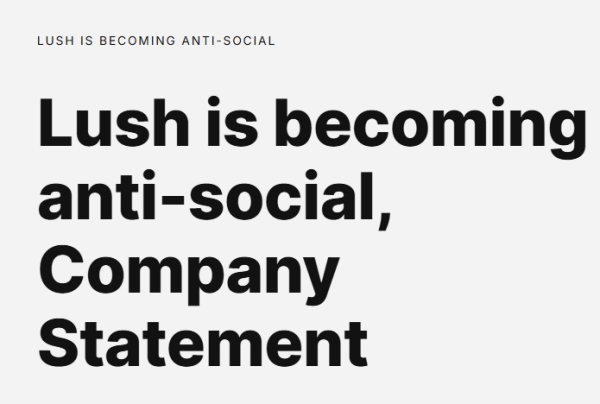
Lush replaced social media with a deliberate, high-touch ecosystem that rewards subscribers with early access, exclusive bundles, and experiential moments in stores. Their Black Friday promotions live where the brand has full control over data, message, and customer journey.
Own your community; don’t rent it. By combining owned channels with ambassador-led content, brands can bypass paid algorithms and build direct, high-value relationships based on trust rather than paid reach.
Prioritize owned channels and high-LTV customers. Removing distractions and focusing on high-intent communication can lead to healthier margins and stronger customer relationships.
Gymshark doesn’t treat Black Friday like a sale. They treat it like a community event. Instead of building a traditional ad push, the brand activates its enormous network of athletes, creators, and micro-influencers with Early Access Codes that unlock the sale days before the public.
Gymshark built its reputation through fitness creators long before paid influencer programs were mainstream. Their Black Friday model simply scales that playbook, letting trusted messengers carry the momentum. Offers come from voices the community already follows, so the promotion feels personal rather than generic.
Community and affiliate strategies maximize reach and conversion in a high-trust environment. Leverage influencers to drive traffic and conversion, integrating them into the sales structure.
Google turned Black Friday into a platform for economic empowerment. Instead of pushing deals, the company used its technology, reach, and data infrastructure to spotlight Black-owned businesses and drive long-term visibility beyond a single shopping weekend.
Google launched an annual initiative in partnership with the U.S. Black Chambers, Inc., supporting Black-owned businesses. Integrated permanent features like Google Maps badges and the ByBlack platform beyond the initial holiday marketing push.
This initiative proved that a massive technology platform could use its power not just for advertising, but for social utility. It demonstrated the power of building permanent infrastructure to support an underserved community year-round.
Established the blueprint for conscious consumerism campaigns that provide genuine technological utility and transparency, moving beyond simple donation promises.

Apple approached Black Friday with the restraint expected from a premium brand. Rather than racing into discount culture, they built a patient, tightly sequenced email campaign that generated demand early while preserving the brand’s sense of value and exclusivity.
Apple consistently refused deep, immediate discounts. Instead, they offered high-value gift cards with purchases. They used a carefully sequenced multi-week email campaign to build anticipation before the offer was revealed.
Apple solved the core problem for every premium brand: how to participate in a deep-discount holiday without cheapening the brand. The gift card strategy maintained price integrity while still offering value.
Showed how to leverage exclusivity and anticipation to capture early budgets without resorting to price wars. The focus on pre-event communication became standard industry practice.

Media Shower’s AI marketing platform helps you keep your company in the black, all year long. Click here for a free trial.