The Better Marketing Blog
Better tips, tools, and tactics for the AI era.
Better tips, tools, and tactics for the AI era.

AI has made marketing teams very good at producing the next asset, whether that means a blog post, an email, a webinar recap, a LinkedIn carousel, or a better version of yesterday’s prompt.
What it hasn’t automatically improved is memory.
Most teams already have plenty of evidence about what their audience wants. It shows up in Search Console queries, sales-call notes, newsletter replies, support tickets, webinar questions, CRM fields, chatbot transcripts, and editorial comments. The insight is usually there. It just doesn’t travel very far.
That’s the failure inside many AI-assisted marketing workflows. The problem isn’t that marketers lack feedback, but that feedback rarely reaches the next brief, the next prompt, or the next assignment.
The content machine keeps moving, while the learning stays behind.
A useful AI content system does more than produce. It remembers what happened after the last piece met the audience.
A typical AI-assisted workflow can look modern from the outside. A team creates a brief, prompts an AI tool, edits the draft, publishes the piece, and checks performance later. The process is faster than the old version, but the learning is still scattered across analytics tools, sales conversations, editorial reviews, and individual memory.
That’s how a team can create more content without understanding its audience any better. The calendar fills. Drafts move quickly. Repurposing gets easier. But the same weak assumptions can keep moving from one asset to the next.
The weak point usually isn’t the data. Most teams already have more signals than they can comfortably process. The weak point is the handoff.
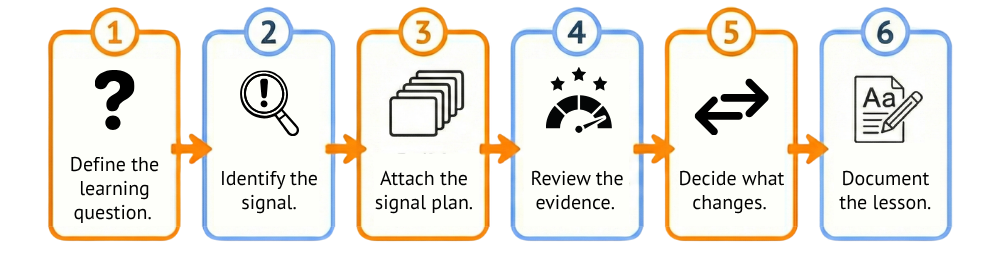
A real learning loop connects publication to the next assignment. It turns content performance into editorial input, strategic input, and better instructions for the next AI-assisted project.
Many marketers treat feedback as something that happens after publication. By then, the team has already made the most important decisions: the angle, audience, structure, source material, title, and call to action.
An effective loop starts earlier, when the team decides what they want to learn from the content. This approach gives each assignment a clear learning question along with its topic.
Before drafting, the team should be able to answer one practical question: what should we know after this content performs in the real world?
Different assets should answer different questions. A thought leadership article, comparison page, sales-enablement piece, webinar recap, and nurture email shouldn’t be judged by the same scoreboard.
Once that question is clear, AI becomes more useful throughout the workflow:
Most marketing dashboards are built to show what happened. That’s useful, especially when leadership needs a quick read on traffic, rankings, engagement, or conversions.
But reporting and learning are two different things. For example, a dashboard can show that:
A good signal plan names the evidence that matters and the decision it should influence.
For instance:
Editorial friction deserves a place in the loop, too. If AI keeps producing generic drafts, thin audience context, or unclear points of view, that pattern is feedback. It may point to weak source material, a vague prompt, an underdeveloped brief, or a missing editorial standard.

This is where many AI content workflows break down. Teams gather performance data, discuss it briefly, then move on to the next deadline.
The next prompt looks almost exactly like the last one, and the next brief repeats the same assumptions. The same editorial problems return because no one turned the lesson into a reusable instruction.
A feedback loop only works when evidence reaches the places where future content decisions are made.
Search Console data, CRM notes, newsletter replies, support themes, and sales feedback all belong in the next assignment when they reveal a gap between what the team meant to say and what the audience needed.
Prompt libraries need the same discipline. Repeatedly generic drafts shouldn’t be treated as isolated tool failures. They often point to thin audience context, weak inputs, or a brief that hasn’t made the point of view clear enough. Blaming the tool every time wastes the lesson.
Existing content should also change when performance reveals a fixable weakness. Rankings without clicks may point to title and meta problems. Traffic without engagement may point to a weak introduction, poor structure, or a mismatch between search intent and the content’s promise.
AI search visibility problems may point to unclear definitions, thin authority signals, or an answer buried too far down the page.
Strategy changes when the pattern repeats. Several weak articles on the same theme can reveal a positioning problem or a misunderstanding of search intent. It could also show that a content cluster matters more internally than it does to the market.

AI is especially useful when the team has too much feedback to interpret by hand. Sales-call notes, customer-support questions, newsletter replies, social comments, search queries, content audits, chatbot transcripts, and performance summaries all contain signals that are easy to miss in isolation.
AI can help turn that scattered feedback into usable editorial guidance. AI tools are great for:
But all of that work still needs human judgment. AI can surface patterns, but the marketing team has to decide which patterns matter. A cluster of customer objections might call for a new comparison page, or a repeated search query might require a stronger definition.
A low-performing article might need a better opening, or it might reveal that the topic wasn’t important to the audience in the first place.

The workflow doesn’t need to start with a complicated technology stack. It can begin as a shared document, a recurring editorial review, or a simple field inside the content brief. The format matters less than the ownership.
Here’s a simple version:
Someone has to be responsible for moving the lesson forward. Without that owner, the team ends up with dashboards instead of learning. Dashboards show what happened, but a feedback loop changes what happens next.
Say a company publishes an AI-assisted comparison page meant to help buyers evaluate its platform against a larger competitor. After a month, the page is getting search traffic, but sales keeps hearing the same question on calls: “Will this replace the tools our team already uses?”
That question changes the assignment.
Instead of asking AI to produce another comparison page with more feature-by-feature detail, the next brief should focus on the buyer’s real concern: integration risk. The prompt should include examples from sales notes, customer language from calls, and a clear instruction to explain how the product fits into an existing workflow.
The content may also need a new section near the top of the page:
“Will this replace my current tools?”
That one change turns scattered feedback into better content. Sales notes become audience context. Audience context changes the prompt. The prompt changes the draft. And the draft gives buyers an answer they were already asking for.
Most marketing teams don’t need more AI-generated content. They need an AI marketing system that gets smarter from what’s actually working.
Media Shower builds that loop into client work. Each month, our team reviews the signals that matter, including organic SEO results, Google AI Overview mentions, traffic from ChatGPT and other AI engines, and audience response. Then we review those findings with the client and feed them back into the model.
Media Shower’s AI marketing platform helps brands build marketing systems that learn from real performance signals, not one-off prompts. Click here for a free trial.