Quick Summary
- A universal insight: Years before “hangry” entered the common vocabulary, Snickers pointed out that people act differently when they’re hungry.
- A breakout launch: The 2010 Super Bowl ad starring Betty White immediately captured cultural attention.
- A repeatable idea: The “celebrity transformation” device created a format that could run for years.
- Global adaptability: Markets around the world used local celebrities while keeping the same core premise.
- Real business impact: The campaign drove 15.9% global sales growth in its first year and generated $376 million in incremental sales within two years.
In the middle of a backyard football game, Betty White lines up for a play.
A pass comes her way. She misses it. A defender barrels into her, sending the 88-year-old actress sliding face-first into a patch of mud. Her teammates are unimpressed.
“You’re playing like Betty White out there,” one of them complains.
She snaps back with a sharp insult, and someone tosses her a Snickers bar.
One bite later, Betty White disappears and in her place stands an ordinary guy, suddenly competent again, ready for the next play.
The tagline: “You’re not you when you’re hungry.”
Betty White: “Football,” 2010
The spot debuted during the 2010 Super Bowl, where ads compete for attention as fiercely as the game itself. By the following morning, the commercial had spread everywhere, from morning shows, to YouTube, to even late-night monologues. Betty White’s performance fueled a wave of earned media that lasted weeks.
As great as Betty was, the most impressive performance turned out to be the ad concept itself.
Joe Pesci and Don Rickles: The Party Crasher, 2010
The Insight Was Hiding In Plain Sight
The strategy behind the campaign started with the simple observation that hunger changes how people act.
Snickers’ agency, BBDO New York, saw an opportunity in that moment of everyday frustration. Instead of marketing the candy bar for its taste or ingredients, they reframed the product as a solution.
When hunger throws your personality off course, Snickers brings it back.
That shift turned a snack into something closer to a behavioral tool. More importantly, it anchored the brand to something highly relatable, that happens to all of us.
A campaign built on that kind of everyday truth has room to run.
Willem Dafoe: “Marilyn”
Building A Campaign Platform, Not Just An Ad
Though the ad was created for the Super Bowl, from the start the concept was designed to repeat.
The structure was almost embarrassingly simple:
- Someone behaves strangely or badly.
- Hunger is revealed as the culprit.
- A Snickers bar restores the person to their real self.
That basic formula created a framework capable of generating dozens of variations without losing clarity. Each new execution felt fresh, but audiences understood the joke instantly.
Advertising history is full of clever ads that never lead anywhere. This one came with a built-in storytelling engine.
The first spot worked so well that the path forward was obvious.
Robin Williams: The Loopy Football Coach
The Celebrity Twist That Made It Memorable
The campaign’s most recognizable device was the transformation between a celebrity and an ordinary character.
Betty White was the first, but others followed.
The device did something subtle but powerful: It gave each ad its own cultural hook while preserving the core idea. Audiences might tune in for Elton John or Joe Pesci, but the punchline always pointed back to the brand.
Aretha Franklin and Liza Minelli: Road Trip
A Global Idea With Local Flavor
Once the campaign gained traction in the U.S., Mars expanded it internationally.
Global rollouts often struggle because humor doesn’t travel easily. What works in one country can fall flat in another.
Instead of exporting identical ads, the Snickers team allowed local markets to reinterpret the concept.
The premise stayed the same, but the characters changed.
Elton John: “Rap Battle”
British versions featured Elton John and Mr. Bean. In Brazil, a football icon. In the Middle East, the Joker.
The humor came from seeing these personalities dropped into situations where they clearly didn’t belong.
The Joker: “The Joker”
Before the Snickers appears, the celebrity version represents the exaggerated “hungry” personality. After the bite, the character returns to normal.
Each market produced ads that felt culturally specific while still delivering the same central message.
Mr Bean (Rowan Atkinson): “Mr Bean — Kung Fu”
Within a few years, versions of the campaign were running in 58 markets, representing roughly 89% of Snickers’ global sales.
Few advertising ideas manage that level of international consistency without losing their personality.
Joan Collins and Stephanie Beacham: “Locker Room”
The Numbers Behind The Campaign
Creative campaigns often get attention without moving the business. Snickers’ platform delivered both. Within the first year after the launch, global Snickers sales rose 15.9%. Then within two years, it generated $376 million in incremental sales.
The Super Bowl launch also created a wave of earned media:
- 400 million unpaid impressions
- $28.6 million in media value
Those numbers helped transform the campaign from a successful commercial into a long-term marketing platform.
More than a decade later, the tagline is still active.
That kind of longevity is rare in modern advertising, where campaigns often rotate every year or two.
Richard Lewis and Roseanne Barr: “Lumberjack”
Why The Idea Still Works
Campaigns fade for many reasons. Cultural references age. Humor stops landing. Audiences grow tired of repetition.
The Snickers platform avoided those traps because its foundation is unusually durable.
The core insight, that people behave differently when they’re hungry, is timeless and endlessly relatable.
The creative structure also leaves room for reinvention. A new celebrity, a new setting, or a new cultural reference can refresh the joke without altering the premise.
In effect, the campaign behaves like a television format: the cast and scenario changes, but the idea stays intact.
Danny Trejo and Steve Buscemi: “The Brady Bunch”
Beyond the Screen
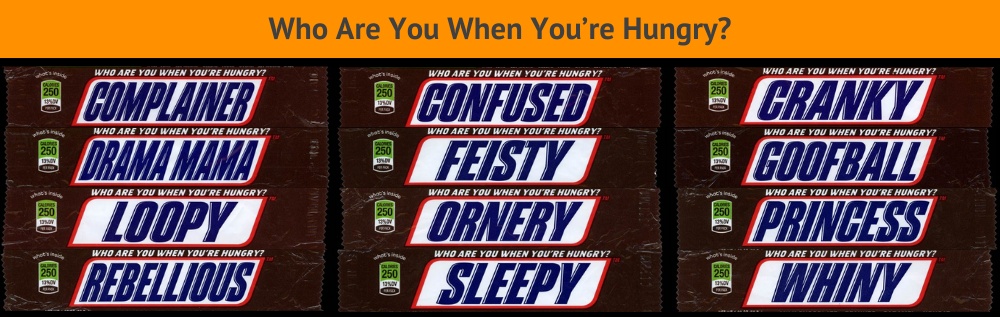
“You’re Not You When You’re Hungry” was so successful that Mars expanded the idea into product packaging.
Instead of the familiar SNICKERS logo, wrappers began appearing with personality traits printed across the front: “CRANKY,” “DRAMA MAMA,” “SLEEPY,” “GROUCHY,” “LOOPY,” and more. Roughly twenty different “Hunger personalities” circulated in stores across the U.S., each representing a version of the person someone becomes when hunger takes over.
The effect was simple and surprisingly powerful.
Shoppers began searching for the wrapper that matched their mood or the personality of a friend. Some people even tried to collect the entire set, turning an ordinary candy purchase into a small social game.
The packaging carried the campaign’s central insight directly onto the product. The same behavioral truth driving the commercials, that hunger changes personality, appeared on every wrapper in plain language.
This shift changed the role of the product in the campaign; it functioned less as an ad and more like brand behavior.
Marketer Takeaways
- Start with a recognizable human moment. Campaigns grounded in everyday behavior are easier for audiences to understand and remember.
- Design for repetition. A strong creative structure can support years of storytelling without feeling stale.
- Use celebrity strategically. Familiar faces work best when they amplify the idea instead of distracting from it.
- Balance global consistency with local creativity. Let markets adapt the execution while protecting the central insight.
- Tie the product directly to the problem. Rather than showing Snickers solely as a product, it positioned the candy bar as the solution to a bigger problem.
Media Shower’s AI marketing platform helps brands turn human insights into sweet results. Click here for a free trial.