The Better Marketing Blog
Better tips, tools, and tactics for the AI era.
Better tips, tools, and tactics for the AI era.
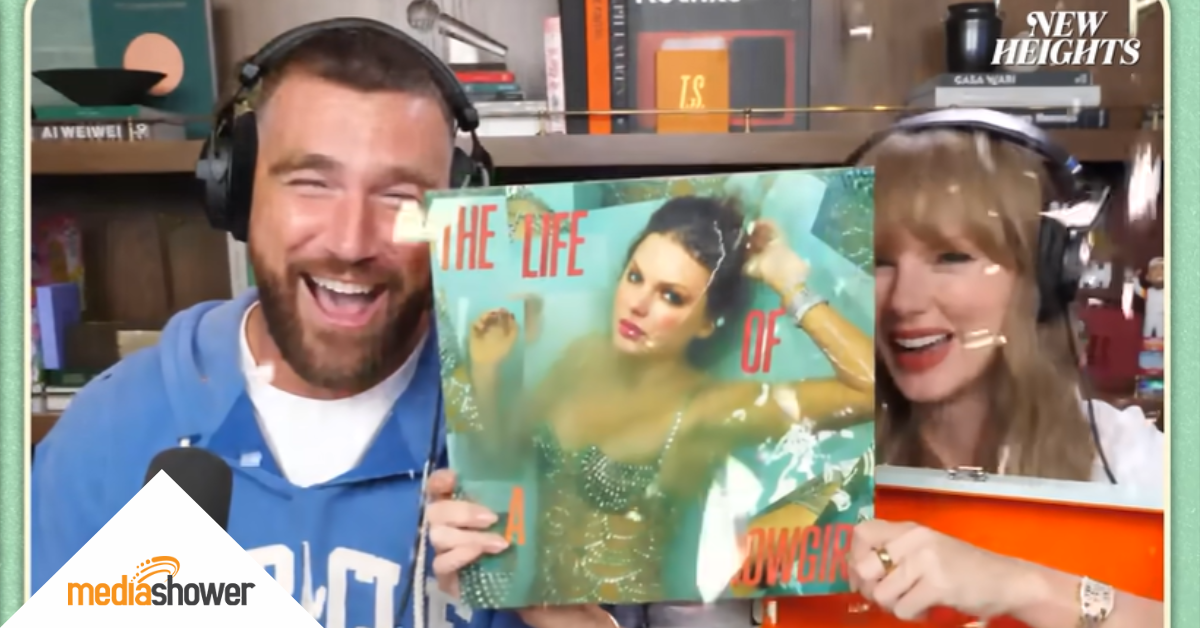
When Taylor Swift and boyfriend Travis Kelce dropped a surprise podcast episode on Kelce’s podcast “New Heights” on August 13, 2025, the internet shattered into a million shareable soundbites.
After months of tabloid headlines and paparazzi photos, the couple were ready to set the record straight. By choosing their own turf to have the conversation, they bypassed the media machine entirely, creating a moment so genuine it sent shockwaves across the internet.
Capping off the historic event, Swift used the platform to make her own major announcement, officially revealing that her 12th studio album, titled “The Life of a Showgirl,” is set for release on October 3rd, 2025.
The episode was an instant cultural event that shattered digital records. The livestream YouTube video pulled in a peak of 1.3 million concurrent viewers, a surge so massive it temporarily crashed the channel’s servers.
Within 24 hours, the episode had amassed 13 million views on YouTube alone. The shockwaves extended across social media, where related clips generated a breathtaking 379 million views on Instagram, 61 million views on X, and 34.5 million on TikTok.
Swift’s appearance also drove a 3,000% increase in new listeners to Kelce’s podcast and a 2,500% spike in average streams for the podcast on Spotify. Female listenership on Spotify increased by 618% in 24 hours. The overall New Heights podcast subscriber base on YouTube jumped by over 500,000, reaching more than 3 million.
For marketers who were paying attention, the moment was a blueprint. Swift and Kelce demonstrated how podcasting, when done right, can become one of the most effective content distribution strategies.
Celebrity podcast moments aren’t new, but this one was different in scale and execution. The Swift episode wasn’t promoted heavily in advance, yet it dominated both mainstream and social media within hours.
Rather than being locked into a walled garden or exclusive format, it was accessible across major platforms. The content was short enough to be consumed on the go, but memorable enough to inspire millions of shares.
From a marketing perspective, the approach checked all the boxes: audience alignment, frictionless distribution, and content that felt authentic. Fans didn’t need a subscription to hear it. They just needed to click play.
The lesson here was something every brand can learn from: When your audience is already listening, sometimes all you need is the right format and the right timing.
The entire YouTube video, August 13, 2025.
Podcasts have evolved far beyond niche hobbyist shows. Over the past five years, they’ve become a core part of how audiences consume content—and how marketers distribute it.
While your team debates whether to post three times or five times a week on LinkedIn, the smartest brands have already moved on. They’re building audiences through a medium that commands 45 minutes of undivided attention at a time.
Audio has become the new front page of the internet:
These are the new realities of content marketing.
“Podcast listeners are not only more diverse, but also deeply engaged, spending an average of over 30 minutes per episode, far higher than most digital content.” – GrowthCurve
Unlike other formats, podcasting offers a combination of flexibility and depth. People listen while commuting, cooking, or exercising. They tune in weekly. They finish episodes.
And they remember what they hear.
For marketers, that creates a rare opportunity: a format where audiences are truly engaged, rather than scrolling past or clicking away. Completion rates are as high as 80%, far higher than blog posts or short-form video.
And because podcasting still feels personal and conversational, listeners are more likely to develop long-term loyalty to the brands or voices behind the mic.
This phenomenon is impacting how brands are investing. HubSpot has built a full podcast network. McKinsey uses its “Forward Thinking” podcast to deepen its credibility with business leaders.
Even traditionally visual brands are branching into audio because it builds trust over time.
As the podcasting landscape matures, so do the choices for where to distribute your content. The big three—Spotify, Apple Podcasts, and SiriusXM—each offer distinct advantages. Understanding these can help marketers position their content more effectively.

Spotify has emerged as a leading player, especially among younger audiences. It offers deep integration with social platforms, in-depth analytics, and built-in monetization tools. It also supports video podcasts and has a large share of podcast consumption globally.
Many brands choose Spotify as their default because of its scale and marketing capabilities.

Apple, meanwhile, remains a go-to for many listeners, especially those embedded in the Apple ecosystem. It’s built into iPhones and iPads, making it easy to discover and subscribe to shows.
While it lacks some of the monetization features of Spotify, it excels at passive discovery and is still one of the top destinations for podcast listening.

SiriusXM occupies a different space: a curated, premium environment often favored by celebrities and high-end media properties. With the acquisition of Stitcher and other podcasting platforms, SiriusXM has signaled that it’s not just for satellite radio anymore.
While its reach may be smaller than Spotify or Apple, its audiences tend to be more loyal and willing to pay for premium content.
Each platform has its place. In many cases, brands don’t need to choose just one. Most podcast hosting tools support distribution to all three.
The key is understanding your audience and tailoring your promotion strategy accordingly.
Understanding each platform’s strengths and limitations helps you make strategic decisions about where to focus your efforts. Here’s how the major players stack up:
Choosing a platform becomes easier when you work backward from your business objectives.
Open platforms like Spotify and Apple Podcasts allow for broad reach and easy discovery are perfect for syndication and reaching decision-makers.
For those targeting younger or more mobile audiences, Spotify stands out. Its deep social integration and mobile-friendly interface make it easy to share content where your audience already spends time.
And with Spotify’s dynamic ad insertion tools, you can experiment with monetization even as you build an audience.
If your brand leans toward luxury, niche markets, or exclusive experiences, SiriusXM might be worth exploring. While its reach is more limited, the audience is often more engaged and accustomed to premium content. Partnering with the right host or network can lend additional credibility.
Regardless of platform, the real differentiator is how well you understand your listener. What are they looking for? When and how do they consume content? Are they searching for information, entertainment, or both?

Every successful podcast begins with a purpose. Before choosing a format, inviting guests, or designing your artwork, ask yourself: What role will this podcast play in your overall marketing strategy?
Your podcast should serve a clear business objective. Defining this from the start will shape your content, tone, frequency, and promotion plan.
If your goal is brand awareness: Focus on topics your audience cares about—even if they aren’t directly tied to your product.
If your goal is lead generation: Use subtle, value-driven calls to action.
If your goal is thought leadership: Position your brand as a credible voice in your space.
Once your goal is clear, every decision—from episode topics to guest selection—should reinforce it.
Think of each podcast episode as a central asset that can fuel multiple forms of content. You’re not just publishing audio—you’re building a distribution engine.
Below are examples of ways to convert every episode.
| Content Type | Best Platforms/Uses |
| Short social media clips | LinkedIn, Instagram, or TikTok |
| SEO-optimized blog summaries | Capture search traffic |
| Quote graphics | Email newsletters or social sharing |
| Audiograms | YouTube Shorts or Instagram Reels |
| Pull quotes | Case studies, sales decks, or presentations |
This multi-channel approach reinforces your message across formats your audience already uses. It also extends the shelf life of each episode, allowing you to get weeks of value from a single recording.
Distribution-first podcasting is about maximizing return on content. When you plan your podcast with post-production and promotion in mind, you create a system that delivers ongoing value.
Use these tips to boost distribution without extra effort:
When you shift your mindset from “create and post” to “create and distribute,” you’ll see greater reach, deeper engagement, and stronger alignment with your broader marketing goals.
The Swift/Kelce podcast episode wasn’t designed for marketing, but it offered a perfect example of how audience behavior has shifted. Listeners didn’t wait for coverage—they sought out the episode, clipped it, shared it, and talked about it.
The content spread because it was accessible, timely, and aligned with what people cared about.
Brands can take the same approach by leaning into podcasting as a relationship-building tool. When you show up consistently, provide value, and make it easy to access your content, your audience will do the work of spreading the message for you.
You don’t need a celebrity guest to go viral. You need clarity about your voice, consistency in your delivery, and a smart distribution plan that aligns with your goals.

Media Shower’s AI marketing platform helps brands find their voice and amplify their message. Click here for a free trial.
Start your free Media Shower trial and get personalized insights on your SEO, competitors, AI visibility, and what to do next.