Quick Summary
- Podcast guesting puts your message in front of exactly the right audience, but the research and outreach that make it work are slow, manual, and hard to scale.
- Media Shower’s AI Podcast Outreach Assistant handles show discovery, pitch generation, and email drafting, producing customized outreach at a pace no human team can match.
- The pitches work because they’re built from your actual content, not generic templates, which means every angle reflects your real ideas and fits the specific show you’re targeting.
- A human stays in the loop for final review and send, which is what gives the process its conversion potential.
- One strong appearance compounds: hosts know other hosts, and a warm referral from a recording that went well outperforms cold outreach every time.
Podcast outreach is harder than it looks.
Podcast guesting is one of the most targeted distribution channels available, and a single strong appearance can reach thousands – or millions – of people for your product, company, or brand.
The problem is getting booked.
Manual outreach is a grind. Identifying podcasts with the right audience fit takes hours of research, and writing a pitch that reflects genuine familiarity with a host’s content, rather than a template with a name swapped in, takes even longer.
Most marketing teams try it once, get inconsistent results, and move on.
Our solution: The Media Shower AI Podcast Outreach Assistant that solves the scaling problem without sacrificing the specificity that makes outreach work.
The demo below shows the Assistant working through a real campaign: finding high-fit shows, generating pitch topics from source material, then drafting a customized outreach email without a human writing a word of it.
How Our AI Podcast Outreach Assistant Works
Instead of asking your intern to research shows and write pitches by hand, you have an AI Assistant do both. It’s trained on your content and guided by outreach best practices, so it can produce customized pitches at a pace no human team can match.
What makes this different from a podcast directory or a generic outreach template is the Assistant is trained on your product and pitch. It uses that knowledge to identify shows with genuine alignment. It even generates pitch topics that reflect your real ideas.
Here’s a closer look at the 3-step process we built into our Podcast Booking Assistant.
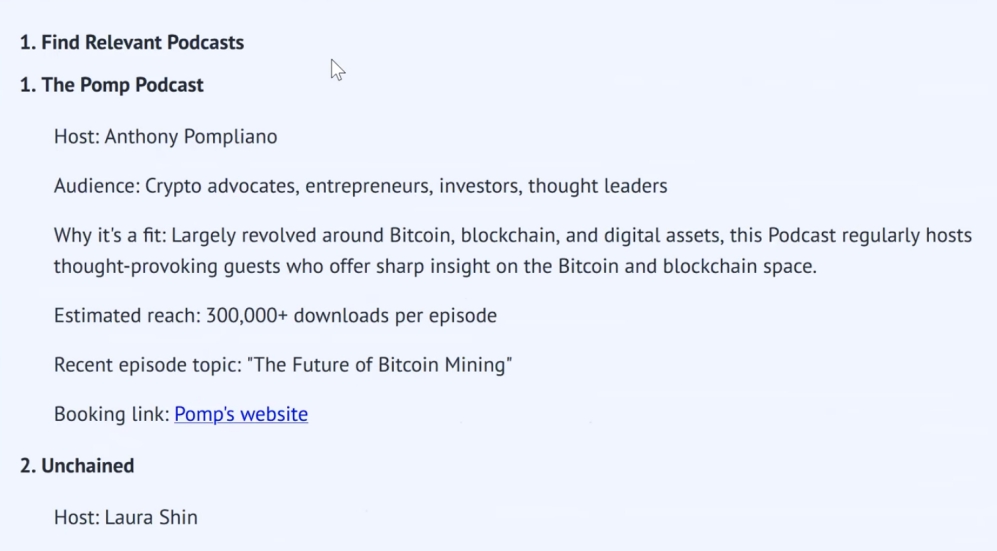
1. Show discovery
The Assistant surfaces podcast matches based on content alignment rather than category tags, looking for best-fit shows. The result is a list that a good human researcher might produce after days of listening and research, but delivered in minutes.
2. Pitch generation
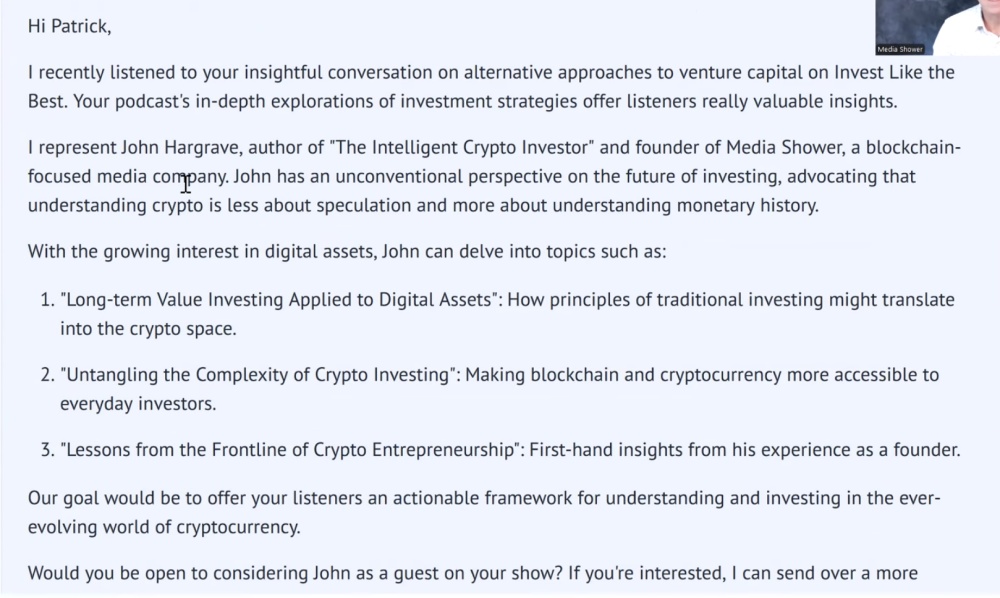
For each show it identifies, the Assistant drafts an outreach email with pitch topics drawn directly from your content and framed for that show’s particular audience.
A personal finance podcast gets a different angle than a business leadership show, even if the underlying content is the same. That level of customization is what separates pitches that get responses from ones that get deleted.
3. Human review and send
The Assistant handles research and drafting. Then, as with everything we create at Media Shower, a human reviews and improves the final output before hitting send.
Hosts are experienced at spotting automated outreach. Keeping a human in the loop is what makes our results better.
What Makes It Work
A few principles drive the results.
Driven by your personal source material
An Assistant trained on your business and brand produces pitch angles that a keyword-based tool just can’t. Whatever you’re promoting, the Assistant uses that as its core model training.
Provides specificity that converts
Hosts read a lot of pitches and know a template when they see one. Pitches that demonstrate real knowledge of a show’s audience stand out. AI makes that level of customization possible across dozens of shows simultaneously.
Scales without losing the human touch
The hybrid model – AI for research and drafting, with a human handling review and improvement – is what makes our solution work so well. Full automation loses the credibility that closes bookings, and fully manual effort simply doesn’t scale.
AI gets you 80% of the way there. You need humans for the other 20%.

Closing the Loop: After the Podcast Event
Most podcast outreach strategies end at “booked.” The appearance happens, the episode goes live, and the next pitch goes out. If you stop there, you’re leaving real value on the table.
Every podcast appearance has not just one, but many promotion opportunities: the first to announce the podcast release, and many clips afterward to remind people to listen.
After the podcast, the Media Shower platform will help you to:
Mine the transcript
Once you have a transcript, feed it back into the Assistant and ask it to:
- Pull the strongest quotes
- Flag moments worth clipping for social
- Draft a blog post or newsletter section based on what you covered
- Suggest follow-up pitch angles inspired by the conversation
- Identify any gaps in your source material that the recording exposed
The Media Shower platform can do all this in minutes. Your team will can have a content map before the episode is even edited.
Improve your Assistant’s training
The transcript also tells you something useful about your own pitching. If you talked about things that aren’t covered in your original model training, that’s a signal to update your Assistant.
The more your AI model reflects what you actually say in conversations, the sharper your next round of pitches will be.
Track what’s working
Ask the Assistant to help you build a simple tracking framework. Include which shows drove traffic, which categories generated follow-up inquiries, which pitch angles got the fastest responses. A structured prompt and a running log is enough to start seeing patterns after a handful of appearances.
Every recording is an input for your content calendar, your source material, and your outreach strategy going forward.
Tips to Sharpen Your Results
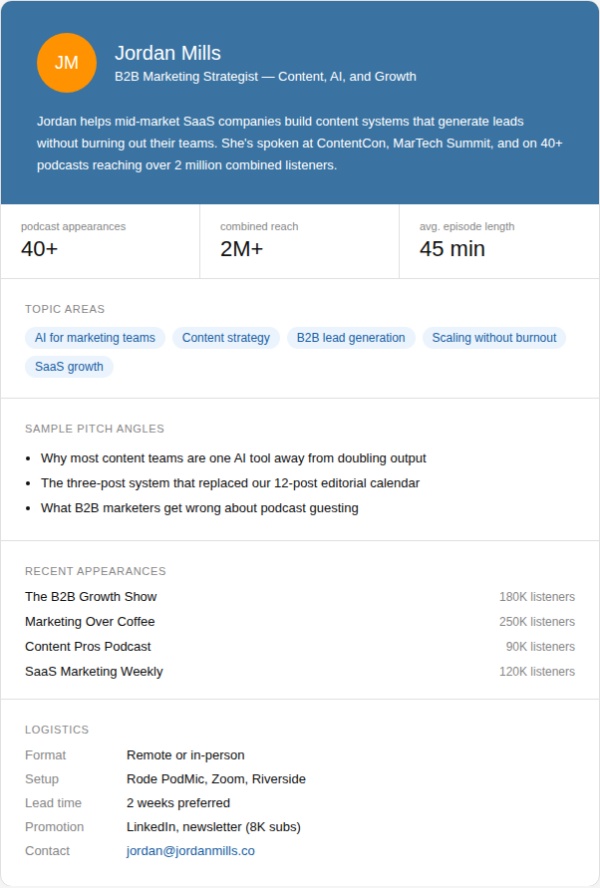
Create a media page before the first pitch goes out
A simple one-pager with your topic areas, past appearances, and audience data removes friction for hosts doing due diligence. It signals that you’re prepared, and it makes the host’s decision easier. Your AI Assistant can draft an initial version directly from the source material it’s already been trained on.
Turn one booking into three
Every host knows other hosts. At the end of a recording that has gone well, ask if they know anyone covering similar territory. A warm introduction from someone who just had a great conversation with you is worth more than ten cold pitches, and building that ask into every post-recording routine turns a single appearance into a compounding pipeline.
Marketer Takeaways
- Podcast tours are a valuable launch strategy. You can reach more high-trust, targeted audiences with a well-executed podcast tour than with paid media.
- Customize the pitch. Hosts can spot a template immediately, and pitches that reflect real knowledge of a show’s audience get read. AI makes that achievable at scale – with humans in the loop to review and improve.
- Quality training drives everything. The Assistant is only as sharp as what you train it on, and a useful body of work produces pitch angles that no keyword tool can generate.
- The hybrid model outperforms either extreme. AI handles research and drafting efficiently while humans handle judgment and relationships. Keep both in the loop.
- One good appearance compounds. Hosts know other hosts. Build the referral ask into every recording, and a single booking becomes the start of a pipeline.
Media Shower builds custom AI Assistants trained on your brand and built around your business. Click here for a free trial.