
Quick Summary
- Your buyers have already moved. 87% of B2B software buyers say AI chatbots are changing their research process, and 50% now start in ChatGPT instead of Google.
- The platform may launch soon. OpenAI is reportedly building an in-house advertising team that could generate billions and bring it to profitability.
- Early positioning wins. Companies building AI visibility and conversational marketing strategies now will dominate when the platform opens to advertisers.
It seems likely that ads are coming to AI search, and it’s going to be the biggest shift in digital marketing since Google AdWords.
For example, half of today’s software buyers are starting their journey with ChatGPT instead of Google. And they’re doing 83% of their research before they talk to a sales rep, so the AI conversation is often the only one that matters.
That shift has massive implications for how products get discovered, priced, and sold. OpenAI knows it. The company is laying the groundwork for a new kind of advertising economy built around conversational intent.
To lead the charge, they’ve tapped Fidji Simo, a seasoned ads powerhouse from Meta, as CEO of Applications.
Behind the scenes, job postings for Growth Paid Marketing Platform Engineers lead many to believe that OpenAI is building an ad platform for ChatGPT right now.
The question isn’t whether ChatGPT advertising will reshape B2B marketing; it’s whether you’ll be ready when it launches.
Here’s how to prepare for ChatGPT advertising.
Why B2B Buyers Have Already Moved to AI Search
B2B buyers were self-guided and digital-first before ChatGPT. They were ghosting sales reps, Googling solutions, and showing up to calls with their minds mostly made up.
The numbers back it up:
- 81% of buyers have a preferred vendor by the time they make contact.
- 85% have locked in their requirements.
- 70% of the buying journey happens before a supplier is even looped in.
(And they consume 13 pieces of content along the way.)
Instead of juggling browser tabs, PDFs, and analyst reports, buyers now just ask what they want to know. They follow up. They dig deeper. And they get real answers from AI, complete with citations from trusted sources like G2, Reuters, and Reddit.
These patterns make a strong case for an OpenAI advertising platform.
What ChatGPT Advertising Might Look Like
Despite what Sam Altman has said about disliking advertising with AI, the writing is on the wall.
Here’s what we think is likely to come:
- Sponsored answers baked into conversations, with questions like “What’s the best CRM?” answered with a blend of organic and sponsored options that are clearly labeled and deeply relevant.
- Contextual targeting based on real-time user queries, not just keywords.
- Branded GPTs (custom tools or assistants) that position your product as the expert solution in its space.
- Follow-up prompts generated by AI. These aren’t banner ads, but rather helpful nudges that guide buyer questions.
Formats are speculative but modeled on current AI capabilities, job listings, and B2B buyer behavior trends.
Here’s the twist: The AI decides who gets the spotlight based on trust and utility, not just ad spend.
To win the ad game, you first need to win the organic game. And that work starts now.
Phase 1: Build Organic Visibility Now
ChatGPT recommends brands it already knows and trusts. Given its growing role in B2B research, it’s not a question of “Should I use generative AI advertising?” but rather “How to advertise on ChatGPT?”
Before you can invest in AI search advertising, you have to earn your spot in the conversation.
This first step is all about building that trust: creating content that answers real buyer questions, establishing credibility with sources people know and trust, and structuring your assets so AI can find (and cite) you.
Create content that answers real buyer questions.
Start by mapping out the actual queries your prospects are likely to type into ChatGPT:
- “Best project management tools for remote construction teams”
- “Compare SaaS platforms with SOC 2 and HIPAA compliance”
- “Top CRM solutions for startups with under 50 employees and HubSpot integration”
Build content that answers those questions thoroughly, like comparison pages, calculators, ROI tools, and industry use cases. (And if you don’t know the questions, ask ChatGPT!)
Establish AI-recognized authority.
ChatGPT pulls from reputable sources. That means reviewing and anchoring your presence on:
- G2, Capterra, Gartner
- Customer case studies with measurable outcomes
- Rich technical documentation
Use structured data (like schema markup) to help AI parse and cite your content accurately.
Think in AI-friendly formats.
AI loves structure. Give your content headers, short answers, and clear takeaways:
- “Top 3 CRM platforms for legal firms under 100 employees”
- “HIPAA-compliant email tools ranked by ease of implementation”
- “Best accounting software for nonprofits with multi-entity support”
It’s SEO 2.0. You’re writing for humans and the machines that guide humans.
Phase 2: Test Early Ad Formats
Conversational AI advertising will be new territory. The brands that test, learn, and optimize early will shape the rules of the game.
Even today, you can start experimenting with branded GPT tools, and track AI-driven traffic to your website.
Experiment with sponsored recommendations.
If and when ChatGPT ads roll out, early adopters will likely get the lowest costs and highest relevance. Explore all of the conversational AI ad formats available. For each format, focus on:
- High-intent queries where your product is the best-fit answer
- Educative ad copy that solves problems, not pitches features
- Real value in every interaction
AI platforms will reward helpful content, not just big budgets.
Launch branded GPT tools.
Build tools buyers want to use:
- ROI calculators
- Compliance checklists
- Maturity assessments
These are helpful utilities that double as lead magnets.
Track what matters for AI.
With AI advertising, you won’t just be measuring clicks anymore.
You’ll want to monitor:
- Mentions in AI responses
- Citation rates in competitive analysis
- Assisted conversions sparked by AI interactions
Use those insights to shape future content and campaign decisions.
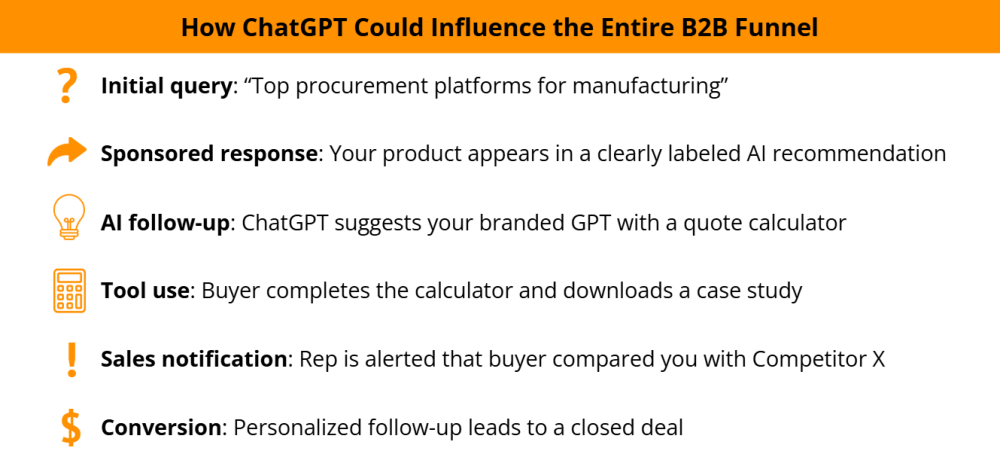
Phase 3: Platform Maturity and Sophisticated Strategy
ChatGPT ads will evolve, just as Google ads have evolved. Your strategy should, too. This is where smart B2B marketers move beyond experiments and into systematized scale.
Create platform-specific strategies.
Developing strategies that leverage the platform’s unique capabilities is key to results.
For example, OpenAI would likely have its own ads manager, with campaign management tools similar to Google Ads and Meta Business Suite. But the strategic approach will be fundamentally different.
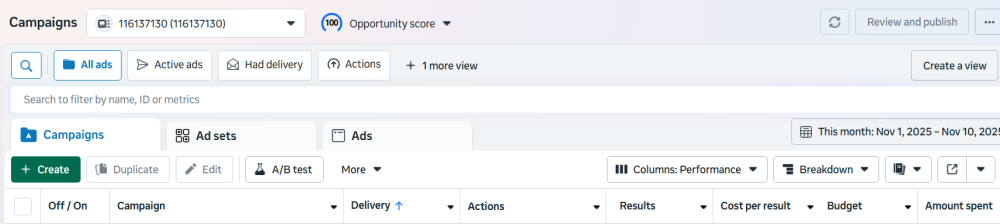
Here, ads complete conversations instead of interrupting them. Measure clicks and conversions in this context to capture the full picture.
Leverage memory-aware campaigns.
ChatGPT can pick up right where conversations left off. Using ChatGPT’s memory features, you can personalize follow-ups:
“Last time, you were evaluating email security platforms…”
Suddenly, you have conversational nurture sequences without needing forms or cookies.
Connect AI research to sales.
Top-tier B2B teams will alert sales reps when AI queries show buying intent. Imagine getting alerts that say:
- “This buyer compared you with Competitor X yesterday.”
- “Here’s what they asked about pricing and features.”
- “They’re evaluating deployment timelines and asked about your onboarding process.”
That’s contextual selling at scale.
The Early Mover Advantage for B2B
Getting in early means more than bragging rights. For B2B marketers, the ROI math is simple:
- High deal values make experimentation worth it. One enterprise win can fund your ad testing for a year.
- Longer sales cycles create more AI touchpoints. That’s more chances to show up and shape the buyer journey.
- Complex buying decisions fit conversational AI like a glove.
When the competition floods in later, you’ve already optimized your strategy, built visibility, and earned AI trust. Today’s positioning work feeds the next quarter’s pipeline.
What B2B Marketers Should Do This Week
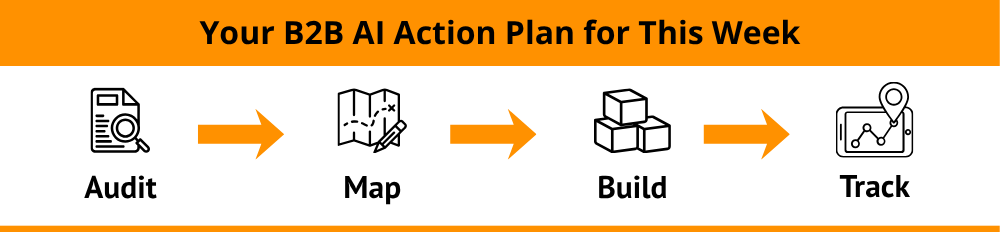
The brands that win on the ChatGPT ad platform will be the ones that start the earliest. While you’re waiting for AI advertising for B2B to roll out, here’s what to do this week to make sure your brand shows up when it matters most.
Audit your AI discoverability.
Go straight to the source to see where you stand. Ask ChatGPT the 10-15 questions your prospects are asking.
Then determine:
- Does your brand show up?
- What does it say about you?
- Which competitors dominate?
Identify gaps and fill them fast. Follow the breadcrumbs to see what made a competitor or content worthy of an AI recommendation. (Read our guide on How to Measure AI Traffic.)
Map high-intent queries.
Tie real buyer questions to your core solutions. Build pages, tools, and assets that speak directly to those questions. Prioritize the questions based on deal value and historical win rates.
Build your first branded GPT.
Create something useful, like an ROI calculator or readiness checklist. Don’t gate it. Just be helpful. (Media Shower can help.)
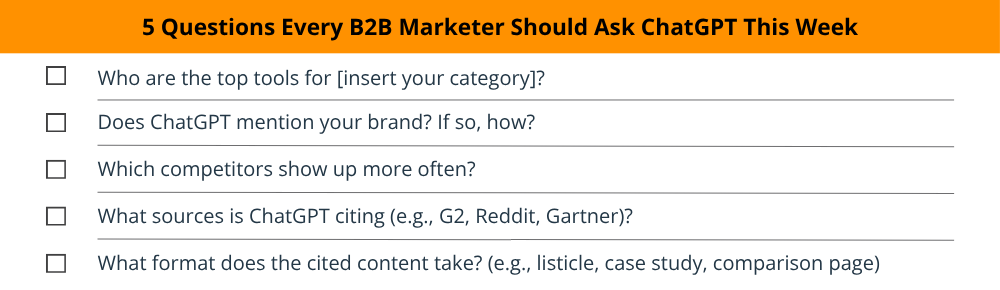
This visibility audit helps brands reverse-engineer why ChatGPT recommends competitors … and how to take their spot.
The New Front Door for B2B Discovery
ChatGPT used to be a novelty. Now it’s the front door to your next big deal.
The brands that treat AI visibility as a top priority today will lead the buyer conversations tomorrow. Those who wait will pay more, compete harder, and play catch-up.
Want to learn more about conversational advertising? See our FAQ below.

Marketing Takeaways
- Start showing up in AI conversations now. If you’re not in the chat, you’re not in the game.
- Think like an AI, write like a human. Structured, scannable, and smart is the new persuasive.
- Get ready to test early ad formats. When the doors open, the early birds get the conversions.
- Build authority signals AI trusts. Your brand should look credible to a machine so it sounds credible to a buyer.
- Embrace the question-and-answer economy. Create content that answers real buyer questions.
- Move fast while the field is still open. The AI ad gold rush is coming: claim your territory now.
Media Shower’s AI marketing platform helps you do all this, and more. Click here for a free trial.
FAQ: ChatGPT Conversational Advertising
Do B2B buyers actually use ChatGPT for purchasing decisions?
Yes: 87% of B2B buyers say AI chatbots are changing how they research solutions. Half now start their search in ChatGPT instead of Google. Sales from ChatGPT recommendations have jumped 436%, and up to 90% of B2B buyers use AI tools during research.
How can B2B marketers prepare for ChatGPT ads before they launch?
Create comprehensive comparison guides, detailed case studies, and technical documentation that AI can quote. Build your presence on review platforms like G2 and Gartner. Develop useful tools like ROI calculators. Track traffic from ChatGPT using specific UTM codes.
Will ChatGPT advertising be expensive compared to other platforms?
Early adopters will likely see lower costs due to less competition, similar to early Facebook ads. The platform will probably use familiar pricing like cost-per-click, but exact costs aren’t known yet. Less competition early on could mean better returns.
What types of B2B companies will benefit most from ChatGPT advertising?
Companies with high-value contracts ($50,000+), longer sales cycles, and complex products will benefit most. The conversational format works well for consultative sales and can handle complicated decisions better than traditional search.
How does ChatGPT handle competitor comparisons in AI responses?
ChatGPT pulls information from multiple sources to compare options based on what users ask. Brands that show up in these comparisons see big advantages: visitors from AI platforms convert 3-5 times more than regular search traffic.
What content performs best for ChatGPT citations?
Content that’s thorough, recent (last two years), and freely accessible works best. Use clear headers and bullet points. Provide facts with sources, detailed use cases, and genuine expertise. Skip marketing jargon and make information easy to find.
Should B2B companies remove gated content to improve AI visibility?
Research shows 79% of AI citations come from open content. While gated content generates leads, you need to balance that against visibility when buyers ask AI for recommendations. Consider ungating your best resources or creating open versions of key content.