The Better Marketing Blog
Better tips, tools, and tactics for the AI era.
Better tips, tools, and tactics for the AI era.
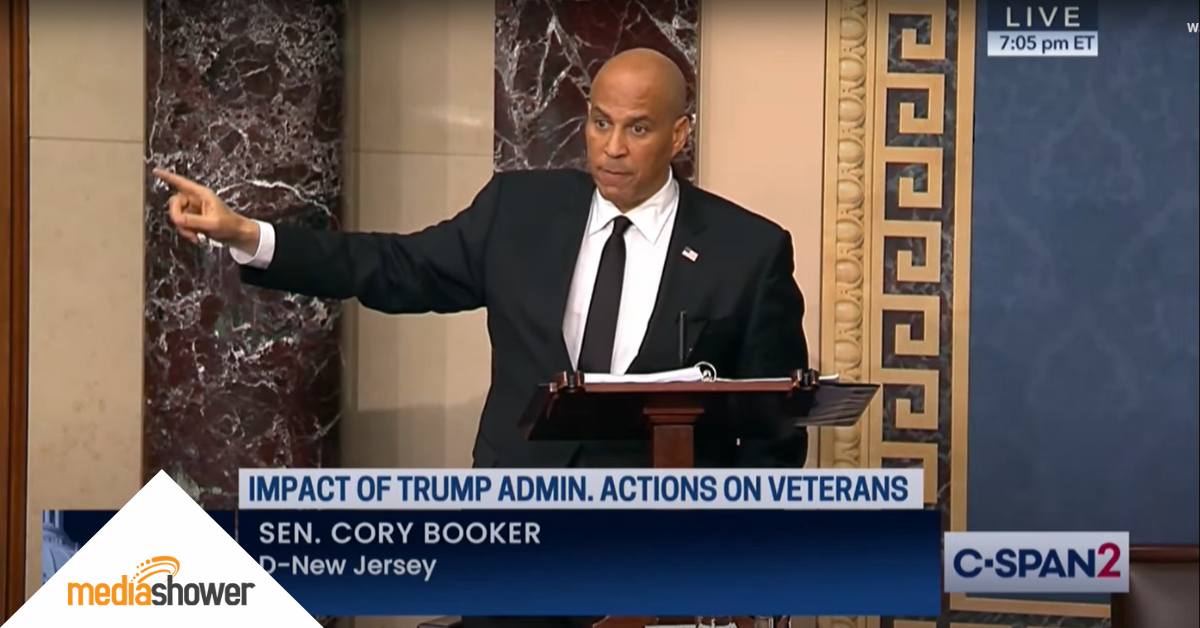
On March 31, 2025, Senator Cory Booker stepped onto the Senate floor at 7:00 p.m. and began speaking. He didn’t stop for more than 25 hours.
By the time he concluded his remarks at 8:05 p.m. the next day, Booker had broken a 68-year-old record, amassed more than 350 million TikTok likes, drawn 115,000 concurrent YouTube viewers, and transformed a legislative procedure into a moment of national attention.
For marketers looking to cut through the noise, Booker’s speech is a case study in message architecture, storytelling, and long-form engagement. It shows how content can capture and hold attention in a digital world with a short attention span.
The beginning of the historic speech.
No, Booker’s speech wasn’t technically a filibuster because he wasn’t trying to block a specific policy or bill. His goal was to attract attention to a political situation he believed deserved national focus.
It was also different in how it was delivered. Previous senators who spoke for hours without yielding the floor often read from policy manuals, the telephone book, or children’s stories—essentially anything to keep talking.
Booker took a more intentional approach. He delivered a cohesive, 25-hour message that was meticulously structured, emotionally resonant, and delivered with clear purpose.
From a marketing perspective, the speech functioned as a live, cross-platform content campaign—broadcast in real time, backed by a compelling message, and designed for engagement.

Booker was responding to a groundswell of concern from constituents, many of whom sent urgent emails asking him to “do something.” The immediate catalyst for the speech was a set of controversial policy shifts implemented by the Trump administration—particularly those related to immigration enforcement, voting rights, and education funding.
Booker saw these actions as threats to civil liberties and democratic norms.
Rather than respond with a press release or a standard floor statement, he took a more personal and high-visibility approach. He chose to speak directly, in real time, and at length.
This extended address gave Booker an opportunity to elevate public concerns, reinforce democratic values, and make a strong visual and emotional statement.
The speech also served as a way to reframe a historical narrative, especially as he approached the mark set by a very different kind of Senate speech decades earlier.
The record Booker surpassed belonged to Strom Thurmond, whose 24-hour, 18-minute filibuster in 1957 was an attempt to block the Civil Rights Act. For Booker, breaking that record was more than symbolic—it was personal.

But he began and ended his speech speaking about John Lewis, the civil rights activist and U.S. Representative who died in 2020 and whom he referred to as his hero and the inspiration for his decision to take action.
This historical framing gave Booker’s speech emotional and cultural weight. What might have remained a procedural footnote instead became a nationally shared moment—broadcast, shared, and discussed across social platforms and news outlets.
Booker’s 25-hour speech not only set a new record for the longest in Senate history but also achieved remarkable engagement across multiple platforms, underscoring the power of strategic content delivery.

Major news outlets provided extensive coverage of the speech, amplifying its reach and impact. The Associated Press, PBS, CBS News, MSNBC, and The Guardian were among those that livestreamed the event, bringing it to a global audience.
The speech resonated deeply within political circles and the general public. Democratic leaders, including former House Speaker Nancy Pelosi and Representative Ilhan Omar, praised Booker for his unwavering commitment.
Republican Senator Lisa Murkowski from Alaska acknowledged the historic nature of Booker’s feat and congratulated him on setting the new record.
While it’s early still, many are saying that his speech has mobilized Democratic leaders, who have been criticized for not doing enough to advance the party’s interests, to take a more active role in resisting unpopular Republican policies.
Others feel that Booker’s speech mobilized Americans on the ground, as well, and led to broader participation in the Hands Off demonstrations held countrywide on April 5, 2025.
This multifaceted impact of the speech highlights how a well-orchestrated message, delivered with authenticity and supported by a robust distribution strategy, can captivate and mobilize a diverse audience.
The speech may have been political in purpose, but it was also a masterclass in communication strategy.
From how it was structured to how it spread, the speech demonstrated core principles of audience connection, storytelling, and strategic distribution.
Here’s how marketers can translate those elements into high-impact campaigns.
Booker’s 25-hour speech wasn’t spontaneous. It was engineered for attention, built on 1,164 pages of prepared content that combined personal stories, policy analysis, and historical references. It wasn’t just long—it was purposeful.
Key components included:
This approach turned the speech into an experience. Each segment was designed to keep the audience emotionally engaged, intellectually interested, and socially active.
Instead of rattling off stats or reading policy documents, Booker told stories. He shared constituent emails, his own reflections, and moments from history—all designed to foster connection.
He anchored his policy concerns in human narratives, which gave his audience an emotional reason to stay tuned and care about the content.
For 25 hours, Booker embodied commitment. He fasted beforehand, managed hydration carefully, remained on his feet, and kept his tie on the entire time. He even had his chair removed to eliminate the option of sitting.
This physical discipline became a visual metaphor for the seriousness of his message, reinforcing credibility in a way words never could.

Throughout the speech, Booker was joined by fellow Democratic senators who would ask long questions to give him a chance to rest his voice. Their participation helped him maintain vocal control while also adding new voices and perspectives to the event.
Members of the Congressional Black Caucus appeared in the chamber at key moments, signaling unity and expanding the reach of the message.
These contributions kept the content dynamic and made it feel like a shared movement rather than a solo performance.
Booker’s team didn’t settle for one feed. They optimized the speech across multiple platforms:
Each channel served a different role in the campaign’s success. Rather than push a single message everywhere, the team tailored the experience to match how users engage on each platform.
Insight: Meet your audience where they already are. Customize distribution for different digital environments to boost engagement and discovery.

Booker’s team turned the 28,000+ voicemails sent during the speech into part of the story. They allowed viewers to feel seen, heard, and connected to the moment.
That two-way energy turned the speech from a monologue into a shared national experience.
Insight: Encourage interaction that feels meaningful. Real-time responses, user submissions, and community contributions drive momentum and deepen brand connection.
The numbers tell a clear story:

Booker’s marathon speech was one of the most watched and engaged-with Senate speeches in history—and it didn’t go viral despite being long. It went viral because it was long—and well-structured, emotionally resonant, and deeply human.
To learn more: Watch highlights on Cory Bookers’s YouTube channel. The entire speech is available on C-SPAN.
Still curious? Check out our frequently asked questions below.
Media Shower’s AI marketing platform helps you build strategic campaigns that go the distance. Click here for a free trial.
What rhetorical strategies did Booker use to sustain engagement and impact?
Booker’s speech was a masterclass in persuasive rhetoric. He used anaphora (repetition of phrases like “I rise…”), allusion (frequent references to historical figures like John Lewis and Strom Thurmond), and pathos (emotional stories from constituents) to hold attention and stir empathy.
He also employed contrast (“This record was set by a man who wanted to keep people like me out of the Senate”) to reframe history and create a clear moral arc.
How did Booker appeal to emotions to help with audience retention?
His tone fluctuated strategically—switching from impassioned pleas to quiet, reflective storytelling—to maintain emotional pacing. This rhythm kept viewers engaged over an unusually long livestream—an advanced tactic for sustaining attention in any content format.
How was the speech structured to maintain coherence for 25 hours?
Rather than rambling, the speech followed a strategic arc. It included constituent stories, historical references, live feedback, and policy critiques—all mapped across 1,100+ pages of pre-written content, segmented for tone and impact.
Were there any criticisms or controversies?
Some critics questioned the political motives or impact of the speech. Others wondered whether such performative tactics could effect real change. Still, even skeptics acknowledged the feat’s technical and rhetorical discipline.
How can brands apply ‘long-form virality’ without going live for 25 hours?
Booker’s key tactic wasn’t just duration—it was intention. Marketers can replicate this by planning serialized content drops, episodic campaigns, or immersive livestreams that are emotionally driven and structurally tight.
Start your free Media Shower trial and get personalized insights on your SEO, competitors, AI visibility, and what to do next.