The Better Marketing Blog
Better tips, tools, and tactics for the AI era.
Better tips, tools, and tactics for the AI era.
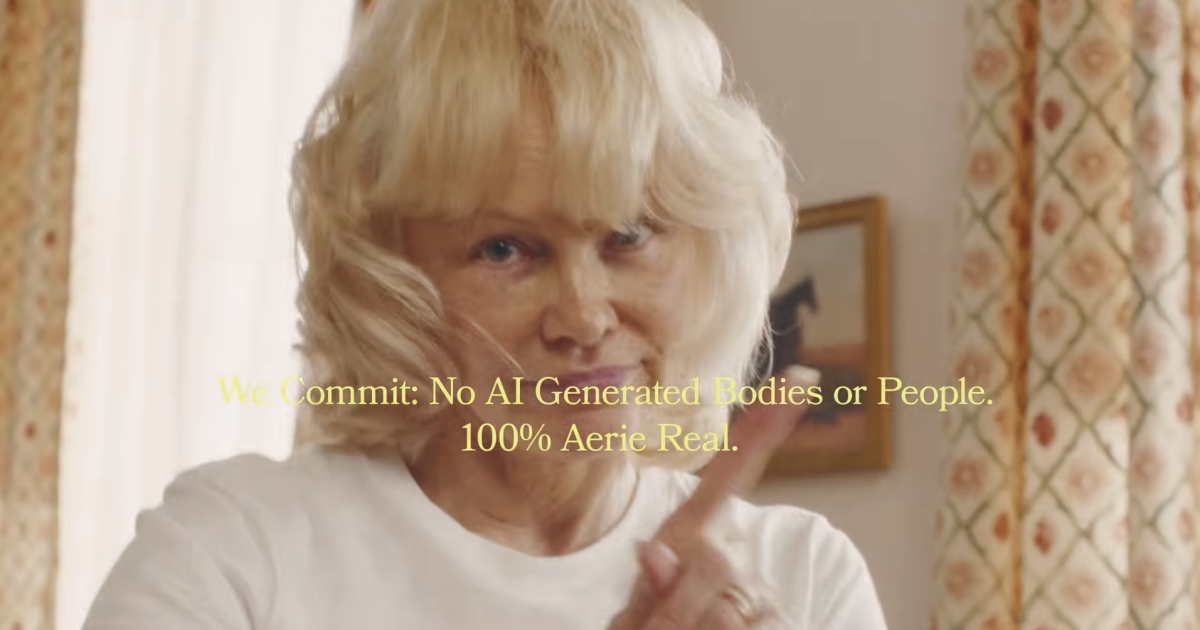
When every brand can generate a perfect person, showing a real one starts to look radical.
In Aerie’s new campaign, a prompt asks AI to create women who are “unique” and “natural.” AI responds the way AI does: by producing several exceptionally polished interpretations of what a machine thinks a natural human should look like.
Then we cut to Pamela Anderson, who has made a public “no makeup” pledge, with real human models surrounding her.
Aerie is making a bet about AI-era marketing: once perfection becomes available to anyone with a prompt box, perfection loses some of its value.
It creates a strange new competitive advantage: freckles, wrinkles, asymmetry, and (gasp!) pores. All the expensive imperfections advertisers spent decades removing may suddenly be evidence that you’re actually looking at a human being.
Imperfection may be the new human ideal.
For Aerie, that’s especially useful territory. The brand built its identity around unretouched models, long before generative AI could manufacture them from scratch. Now it’s updating the same promise for a stranger age: when anything can look real, being real stands out.
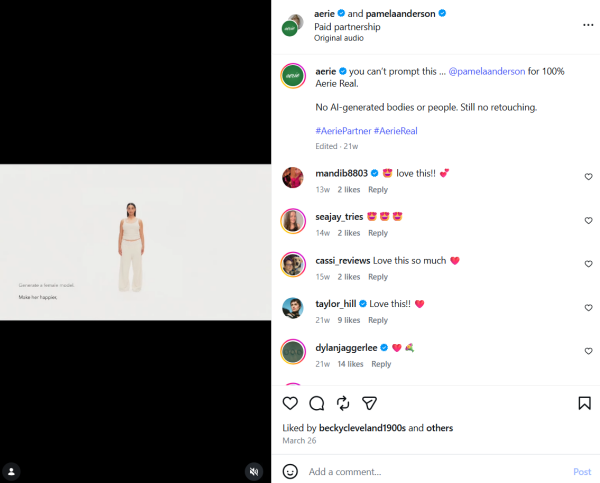
There’s a sizable enthusiasm gap between the people making AI ads and the people looking at them. IAB’s 2026 research found that 82% of advertising executives believed Gen Z and Millennial consumers felt positive about AI-generated advertising.
Among those consumers, only 45% actually did.
Gen Z was particularly skeptical. Thirty-nine percent felt negatively about generative AI ads, versus 20% of Millennials. Gen Z respondents were also more likely to describe brands using AI advertising as “inauthentic,” “disconnected,” and “unethical.”
Apparently, the AI advertising industry has been grading its own homework.
This gap gives Aerie room to move in the opposite direction. When competitors gain access to the same image generators, the same visual polish, and increasingly similar creative possibilities, doing something different becomes distinctive.
The tension is more useful than a simple pro-AI/anti-AI split. People are already encountering and using AI in plenty of contexts. What matters to brands is where customers welcome AI-generated content and where it starts making them suspicious.
Aerie made the boundary razor-sharp, so people can see the difference.
Aerie stopped retouching models in 2014
Aerie prohibits generative AI from creating or altering people and bodies in its marketing. (It still leaves room for AI-assisted planning, and internal applications that don’t generate people or products.)
“AI is bad” is an impractical rule for our modern age. “We won’t AI-generate the people wearing our clothes” is a rule a company can actually follow.
Aerie launched Aerie Real in 2014 with a pledge to stop retouching its models. In October 2025, the company updated that commitment for generative AI, promising that it wouldn’t use the technology to create or alter people and bodies. Then Pamela Anderson became the face of “100% Aerie Real” in March 2026.
The tools changed dramatically over those 12 years, but Aerie barely had to change the promise.
Continuity is doing a lot of work. A brand suddenly discovering its deep commitment to humanity six months after customers sour on AI would invite some questions. Aerie can point to their back story.
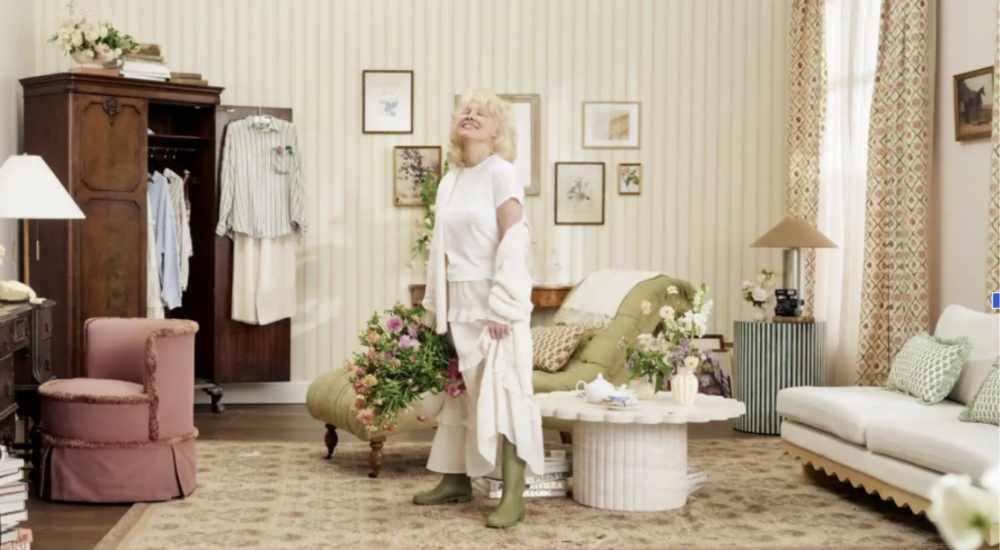
Celebrity endorsements usually require a small act of imagination. We’re asked to believe that a famous person has developed unusually strong feelings about this sneaker, credit card, protein shake, or midsize SUV.
Aerie has less explaining to do with Pamela Anderson.
Anderson has become culturally associated with going makeup-free and reclaiming her public image. Her story already carries the campaign’s movement away from manufactured perfection and toward self-defined beauty. Aerie barely has to hand her the argument.
Makeup-free Anderson in a 2025 Interview with Harpers Bazaar
The campaign makes the fit literal. Anderson asks AI for natural, distinctive women, rejects the synthetic results, and joins a diverse cast of real models. A corporate policy that could have lived quite happily in a press release becomes a simple human choice.
It’s the better version of celebrity casting: find someone whose existing story does half the copywriting. Aerie extends the idea behind the camera as well, labeling creative work with phrases such as “shot by real people” and “real people made this.”
It’s a direction where advertising is likely heading. Food companies tell us something is organic. Clothing companies tell us where a garment was made. In an increasingly synthetic media environment, brands may start treating human creative provenance as information worth putting on the package. “Real people made this” could become a feature.
Aerie announces their no-AI pledge in 2025
People certainly noticed when Aerie formalized the pledge. Its October 2025 announcement reportedly became the brand’s most popular Instagram post, drawing more than 40,000 likes. Aerie also reported a double-digit increase in brand awareness during the fourth quarter.
The business had a strong quarter, too. Aerie comparable sales rose 23% in Q4. AEO leadership said fresh marketing campaigns supported higher demand.
Aerie also had products to sell, stores to run, prices to set, and merchandise to distribute. Giving one Instagram pledge credit for a 23% comparable-sales increase would be the sort of attribution model marketers normally complain about.
What we can say is more interesting anyway: Aerie’s authenticity positioning is getting attention while the business grows.
The promise has the ingredients of a durable brand claim. It addresses a real customer anxiety about synthetic imagery. It also extends a position Aerie established years before the generative AI boom.
Most importantly, Aerie has attached an operating rule to the marketing, separating positioning from decoration.
Calling a brand “authentic” is easy. Deciding that certain technologies are off-limits because they conflict with brand values costs the company something. That cost is what makes the promise believable.
Media Shower’s AI marketing platform is built to empower humans, not replace them. Click here for a free trial.
Aerie pledged against using generative AI to create or alter people and bodies in its marketing. The policy extends its long-running commitment to showing unretouched models and presenting products on real people.
Aerie’s position doesn’t prohibit every use of AI. The brand permits applications such as planning while rejecting AI that creates, replicates, or alters people, bodies, and products in advertising.
Pamela Anderson’s public association with makeup-free appearances and self-defined beauty aligns naturally with Aerie’s authenticity message. Her public identity makes the campaign promise tangible.
Consumer attitudes are mixed. IAB research found that younger consumers were considerably less positive about AI-generated ads than advertising executives assumed, with Gen Z expressing particularly strong concerns about inauthenticity.
It can when the promise addresses a genuine customer concern, fits the brand’s established identity, and is backed by clear operating standards. The boundary gives the claim credibility.