The Better Marketing Blog
Better tips, tools, and tactics for the AI era.
Better tips, tools, and tactics for the AI era.

Google search:
“CRM software”
ChatGPT conversation:
“We have 200 employees, HubSpot no longer fits us, Salesforce seems too complicated, and our sales team needs something that integrates with our existing stack.”
A Google search tells you what somebody searched for.
A ChatGPT conversation tells you what they’re trying to solve.
That’s the potentially revolutionary thing about ChatGPT Ads.
Since ChatGPT rolled out self-serve ads in 2026, we’ve pulled together all the early results from real marketers using the platform – along with what’s working, what’s not, and what you should do next.
Getting started with ads in ChatGPT
First, ChatGPT Ads really are something different from Google Ads.
That’s because Google Ads just target a topic (i.e., a single keyword). ChatGPT Ads give you conversational context.
ChatGPT’s targeting model reflects the difference. Advertisers can provide context hints describing relevant conversations, needs, topics, or keywords. OpenAI says those hints guide matching but aren’t equivalent to exact-match keywords, as in Google.
Instead, ad groups are organized around themes or intent areas.
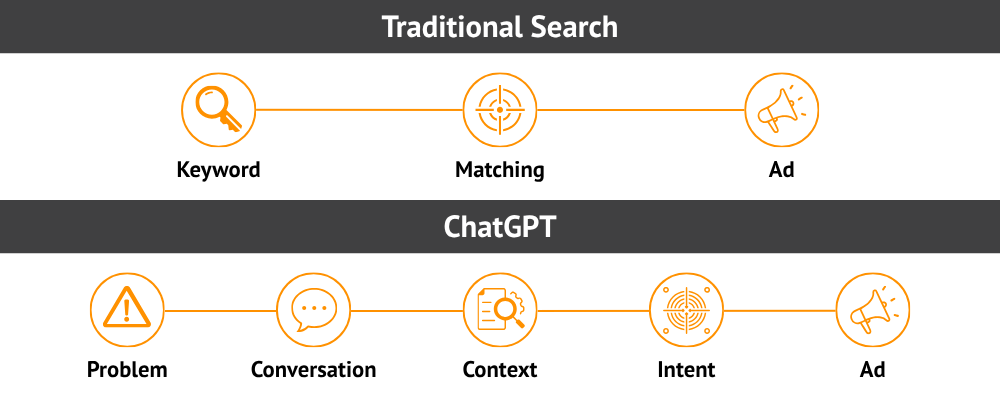
Q1Media’s early experience is that campaigns built around specific customer pain points have worked better than broad categories, with more decision-oriented language such as comparisons and reviews also producing stronger results.
That’s one agency’s experience, not an industry benchmark. But it points toward the new reality: conversational advertising requires marketers to stop thinking like keyword buyers and start thinking like customers explain the problem in plain language.
That is a meaningful new ad channel.
Here’s the catch: a lot of the B2B audience may never see the ads.
OpenAI has kept several paid ChatGPT tiers ad-free, including Business and Enterprise. Professionals and corporate users willing to pay for ChatGPT can remove themselves from the advertising inventory altogether.
For a consumer brand selling sneakers, ChatGPT Ads could work. For a software company trying to reach CIOs or marketing executives, it’s not very practical if most of your prospects don’t even see the ads.
Independent research gives the early ecosystem an even more consumer-heavy look. A 2026 academic study collected more than 3,000 ChatGPT ads from 186 advertisers using 91 synthetic accounts. It found that the ads skewed heavily toward consumer goods and remained clearly separated from ChatGPT’s response text.
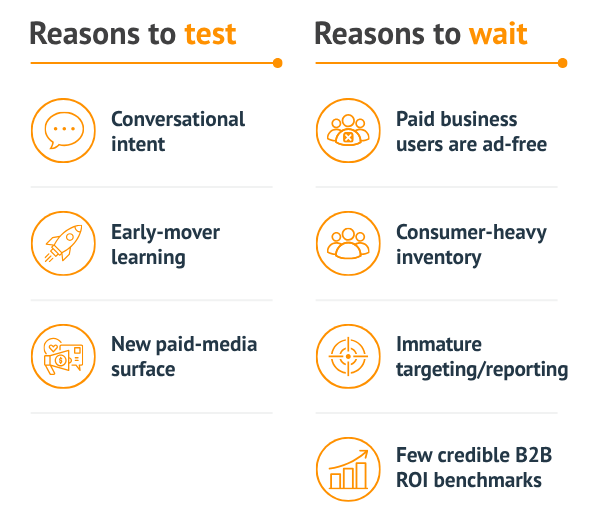
That doesn’t mean ChatGPT Ads will remain consumer-heavy forever. It does mean B2B marketers are showing up at a party for somebody else.
Q1Media is more explicit. Based on its campaign experience, the agency says it wouldn’t currently recommend ChatGPT Ads for B2B, pointing specifically to the prevalence of ad-free paid plans among likely business users.
The agency reports roughly $5 average CPC, CTRs of about 0.5% to 2.5%, and conversion rates around 2% across its own campaigns. Those figures are Q1Media’s results, not market-wide benchmarks.
Discussions on r/PPC are predictably messier, with advertisers describing everything from promising traffic to zero leads, alongside limited reporting, attribution questions, and too little data for confident conclusions. That’s anecdotal evidence, but it reinforces the same caution from the field: there’s still a lot of beta in this beta.
ChatGPT Ads have some promise, but B2B marketers still need proof that the signal reaches enough of the right people and produces valuable business outcomes.
Forget the usual first question: “Can ChatGPT beat our CPC?” The answer, for now, is probably no. A better experiment asks whether ChatGPT can identify stronger intent.
Choose one ICP, one specific pain point, and one conversion offer. Build the context hints around the way that person would actually describe the problem, including the frustrations, alternatives, objections, and requirements that tend to emerge when somebody is seriously evaluating a purchase.
Then compare the campaign against an existing Google or LinkedIn program across the whole funnel:

If a prospect has already told ChatGPT what software they use, what they dislike about it, what they need instead, and what’s holding up the purchase, that prospect should theoretically carry more useful intent than somebody who typed three words into Google.
OpenAI now provides reporting and conversion measurement in Ads Manager, including conversion events sent through its Pixel or Conversions API. It’s also begun supporting conversion-optimized campaigns.
Q1Media recommends treating ChatGPT as an incremental test channel rather than replacing something already working in the media mix. An emerging platform should earn more budget by producing better business outcomes, not by producing a novel dashboard.
A useful B2B test answers one narrow question:
Can OpenAI turn that richer context into better prospects?
There’s one more wrinkle marketers will need to iron out. OpenAI says advertising is separate from ChatGPT’s underlying answers. Buying an ad gives a brand paid placement alongside a conversation, but it doesn’t buy influence over what ChatGPT says.
That gives marketers two distinct AI visibility jobs:
They can occupy the same screen while requiring very different strategies. That may ultimately be more important than the first few months of ChatGPT Ads performance. AI is creating both a new paid-media surface and a new kind of organic discovery environment. Smart marketers will learn how the two interact without confusing one for the other.
You can buy the ad, but you’ll still have to earn the answer. That’s what we do at Media Shower.
Media Shower’s AI marketing platform helps B2B marketers improve their ChatGPT visibility. Click here for a free trial.
Yes. OpenAI is actively expanding ChatGPT advertising and its self-service campaign tools.
ChatGPT Ads can use context hints based on conversations, topics, needs, and keywords to guide relevance rather than relying exclusively on conventional keyword matching.
There’s too little evidence to call them a proven B2B acquisition channel. One agency with live campaign experience currently advises caution, partly because many business-oriented users are likely to be on paid, ad-free ChatGPT plans.
There’s no reliable industry-wide benchmark yet. Q1Media reports an average CPC around $5 in its own campaigns, with results varying by vertical and targeting specificity.
Current evidence supports a controlled test rather than a major budget shift. Public B2B pipeline and ROAS benchmarks remain too thin to justify treating ChatGPT Ads as a proven replacement channel.