The Better Marketing Blog
Better tips, tools, and tactics for the AI era.
Better tips, tools, and tactics for the AI era.
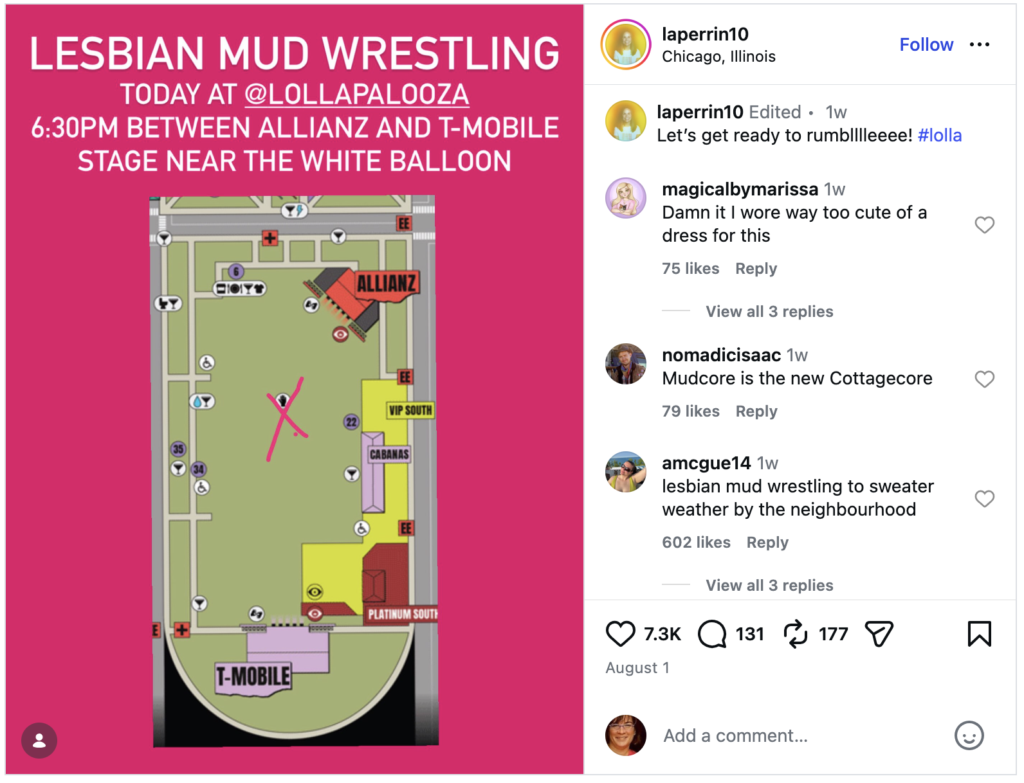
Lindsay Perrin’s mud-wrestling invitation had racked up more than 100,000 Instagram views before she even reached the mud.
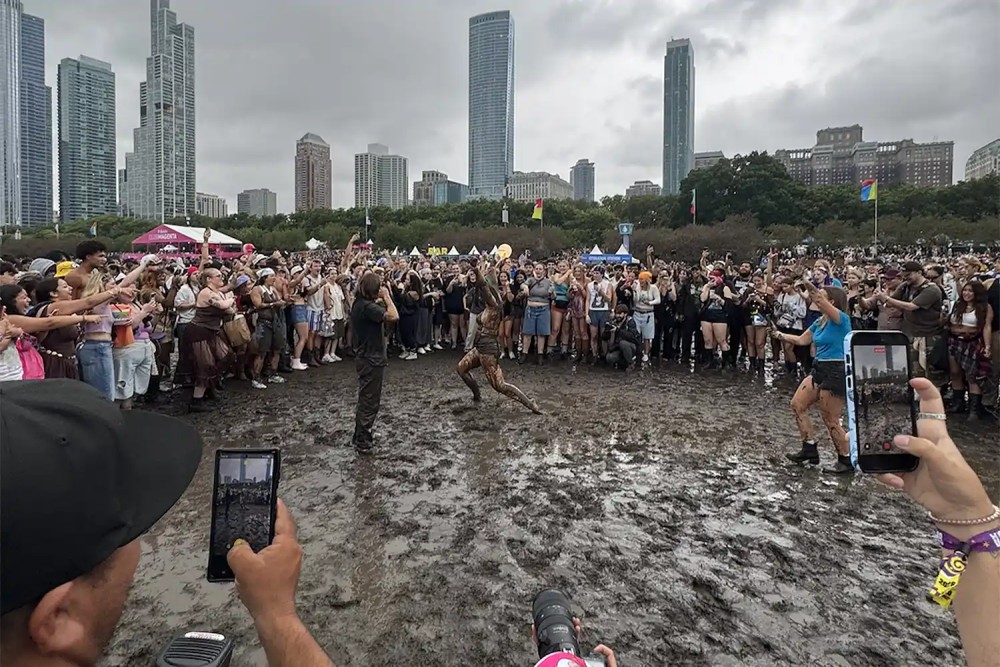
At Lollapalooza 2026, Perrin turned the festival’s soggy grounds into an impromptu mud-wrestling meetup called “Scissor Slam 2K26,” promoted with a graphic on Instagram. Hundreds of people reportedly showed up, creating something stranger and more useful to marketers than another viral festival post: the content generated its own live event.
The episode captures what Lollapalooza does unusually well. One festival produces thousands of moments that escape the boundaries of Grant Park — traveling through broadcasters, publishers, artists, brands, creators, and fans while the main event is still underway.
For marketers, the lesson is bigger than “post more from your event.” The opportunity is to design events with shareable moments, so every posting from attendees has the potential to become its own media asset.
Clips should be instantly understandable, not needing a paragraph of context.
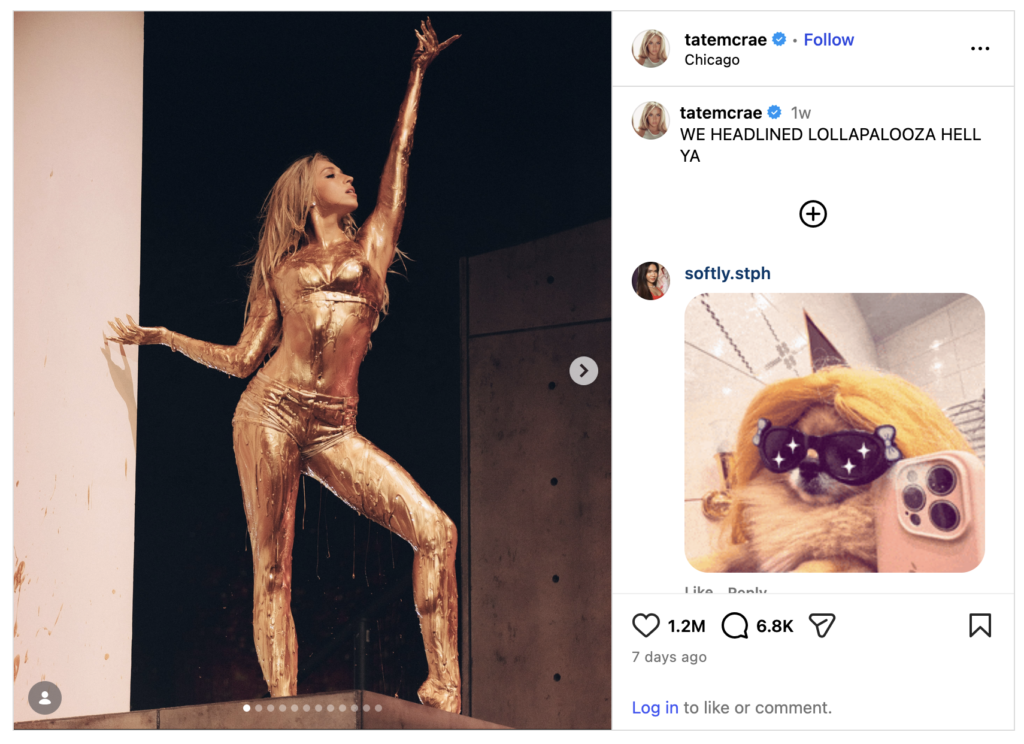
Tate McRae’s Lollapalooza finale had no such problem. Her team created a skin-safe metallic gold liquid for a finale that ended with McRae submerged in the stuff, surrounded by 1,000 aerial fireworks. People reported that 660 gallons were sourced for the production.
Tate McRae – Lollapalooza 2026 (Full Set)
The production was elaborate, but the content was wonderfully simple: Tate McRae got dipped in gold.
It worked as a concert memory, Instagram post, short video, entertainment headline, beauty story, and backstage feature. Allure devoted an entire piece to how the effect worked, while People separately covered McRae’s Lollapalooza beauty look and its use of Neutrogena products.
A People Facebook video of McRae’s gold finale had drawn about 551,000 views by August 10, while Billboard’s version had added roughly 24,000 more. One spectacle was already becoming multiple media assets for different publisher audiences.
Surprise collaborations are just as portable. Lorde brought Charli xcx onstage for Girl, So Confusing, a moment Vulture singled out in its coverage of the festival’s standout performances.
Lorde + Charli xcx team for “Girl, So Confusing”
Olivia Rodrigo joining the Smashing Pumpkins for Thirty-Three produced the same kind of fragmentation. A Cover Nation YouTube upload of the performance drew about 121,000 views within its first week, while a Dovedotcom version attracted roughly 77,000 more.
Other YouTube uploads, Facebook, and Instagram posts accumulated additional audiences of their own.
Olivia Rodrigo with the Smashing Pumpkins
Not every event needs a stunt, but some moments deserve to be designed with a second life in mind.
At a B2B conference, that might be a product demonstration, a surprising research finding, an unexpected pairing of speakers, or an audience question that produces an unusually clear answer.
The point is to identify the moments with enough value, surprise, or clarity to survive outside the room.
A 45-minute keynote may contain six moments that meet that standard. Treating the keynote as a single piece of content leaves five of them buried inside it.
A useful test is simple: Could someone who missed the event understand why this moment matters?
If yes, you probably have more than a moment. You have an asset.
Lollapalooza already has a formidable media operation before the audience starts publishing.
The 2026 festival featured more than 170 artists across eight stages. Hulu and Disney+ carried the official livestream, with Hulu offering two simultaneous channels, plus interviews and behind-the-scenes coverage.
Then everybody else starts publishing too.
Artists publish performances and backstage material. Reporters isolate individual stories from full sets, while sponsors document activations.
Creators package the festival for their own audiences, and fans post the brief moments they cared about most.
Same festival, thousands of publishers, each turning the event into different kinds of content for many different audiences.
Lollapalooza producer C3 Presents is part of Live Nation Entertainment, which has been building around this kind of distributed publishing deliberately. Live Nation’s broader festival work with Dunkin’ sent creators to activations across five festivals, including Lollapalooza.
The program produced 100 pieces of TikTok and Instagram content for creators with more than 16 million combined followers. It generated more than 12 million impressions.
Those figures apply to the five-festival program, not Lollapalooza 2026 alone. Even with that qualification, they show the scale available when creator distribution is planned as part of the event.
Live Nation has described live music as a “real-time content machine.” The phrase works because the machine has far more publishers than people with “social” in their job titles.
For a corporate event, those publishers might be employees, speakers, customers, analysts, partners, creators, and attendees. The goal is to give these very different publishers enough worthwhile material that several different stories can emerge from the same event.
Lollapalooza 2026: Highlights from the BMI Stage
The traditional event recap has a timing problem; it concentrates most of the publishing effort after the event is over.
Footage must be collected, edited, approved, and turned into a polished highlight reel, all of which takes time.
That asset can still be useful, but it misses much of the period when speakers, attendees, customers, and industry audiences are already focused on the event.
A better content system begins before opening day.
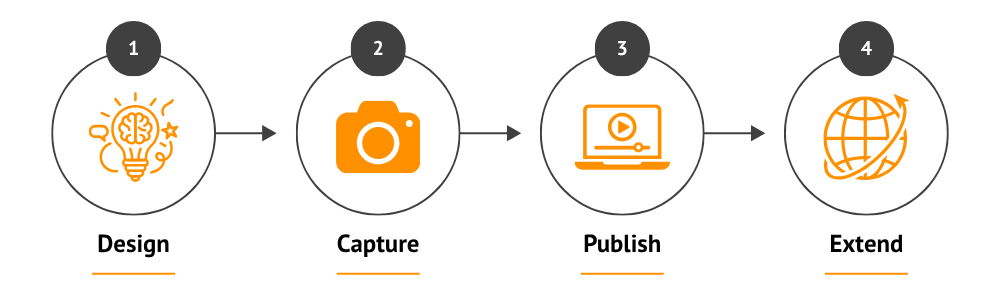
During event planning, identify the parts of the event most likely to produce a clear payoff.
Reveals, demonstrations, collaborations, audience participation, strong reactions, and surprising findings are easier to package because the audience can see what happened and why it matters.
McRae’s gold finale is the stadium-sized version, but the same principle scales down to a surprising chart appearing during a conference presentation or a live product demonstration that produces an immediate result.
The question belongs in event planning early: What will people pull out their phones for?
You don’t need to manufacture empty spectacle. You only need to recognize which parts of the event contain enough surprise, usefulness, emotion, or visual interest to survive outside the room.
One camera records what happened. Ten people may then find ten different stories inside it.
Speakers, employees, customers, creators, partners, and attendees bring different interests and audiences to the same room. Give them appropriate access and useful capture opportunities, and the event starts producing far more than official photography and a highlight reel.
For marketers, “Did we film it?” is a low bar.
A better question is: How many useful stories did we capture?
That may mean planning creator access, identifying speakers who can record quick reactions, preparing customers for short interviews, assigning people to specific sessions, or simply making sure the strongest demonstrations can be seen and recorded cleanly.
Watch Tate’s golden moment on YouTube
Scissor Slam is the wonderfully ridiculous version of real-time publishing: a post about something happening at the festival caused a new thing to happen at the festival. Corporate events usually produce fewer mud-wrestling tournaments, but the feedback loop still works.
A strong morning keynote clip can feed the afternoon conversation. An attendee reaction can show the content team which idea has caught fire. A customer question can become an FAQ before the closing session.
Waiting for the recap is a wasted opportunity. Your audience is paying attention now, and that attention has an expiration date.
Lollapalooza also stretched beyond Grant Park in ways that had little to do with clipping performances for social media. For the first time in 2026, Disney+ joined Hulu in livestreaming the festival, expanding the event to viewers around the world.
Lollapalooza also became the first real-world festival incorporated into Live Nation and Livewire’s Music Festival Tycoon on Roblox. The experience lets players build stages, book artists, sell virtual merchandise, and create festivals of their own.
When Live Nation announced the Lollapalooza integration, Music Festival Tycoon had already generated more than 3.5 million visits and 23 million in-game performances.
A festival becoming a game environment is a useful analogy for marketers thinking about “event content.” The raw material can go well beyond video clips.
A conference can become articles, short-form video, executive commentary, customer stories, research graphics, sales material, FAQs, podcast conversations, email content, training material, and follow-up programming.
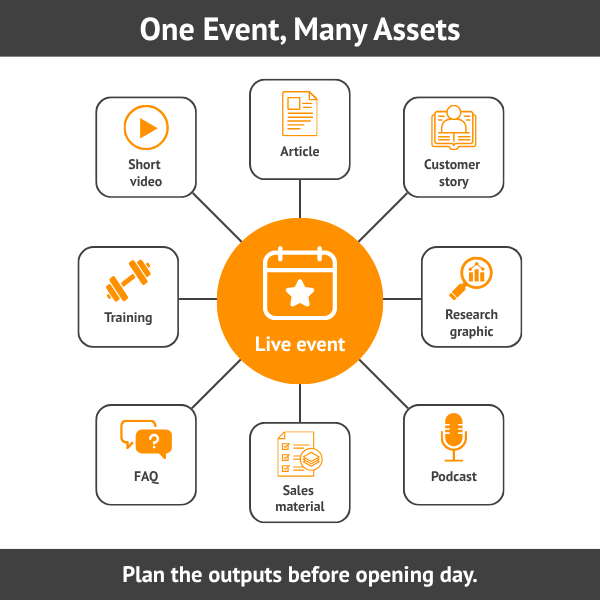
The important shift is to identify those outputs before opening day rather than discovering them while sorting footage afterward.
Lollapalooza’s playbook works because thousands of people turn pieces of the event into media for other audiences.
Your annual conference probably has fewer fireworks, but the content opportunity is surprisingly similar.
Media Shower’s AI marketing platform helps brands turn event moments into content that keeps performing. Click here for a free trial.
Distributed event content is material from one event that is repackaged and spread through multiple channels, publishers, creators, brands, and audiences. Instead of treating the event as one experience with one official recap, marketers turn individual moments into media that can travel independently.
The strongest moments usually contain a clear surprise, transformation, contrast, reaction, collaboration, or visual payoff that audiences can understand quickly. The less context required, the easier the moment is to package for another audience.
Identify likely content moments before the event, create multiple capture points, involve creators and attendees, publish while attention is concentrated, and package individual moments for different channels and audiences.
Real-time publishing lets event content participate in the conversation while audience attention is still concentrated. It can also reveal which ideas are resonating and create new opportunities for content before the event ends.
Treat a live event as a distributed content system that produces many standalone media assets, rather than one experience followed by one recap.