Quick Summary
- The U.S. military invented modern marketing under wartime pressure, with no precedent and no option to fail.
- From WWI posters to WWII celebrity bond drives, the government pioneered direct-response advertising, cause marketing, and influencer campaigns decades before marketers began selling goods and services online.
- The Gulf War introduced the product demo as media strategy.
- Iraq gave us embedded journalism, where access itself became the narrative control mechanism.
- “Be All You Can Be” and America’s Army proved that identity-based positioning and value-first content outlast every feature-benefit campaign ever written.
- The playbook is still running — on Twitch, TikTok, and in Pentagon-approved blockbusters — and it keeps producing results.
You might think that Madison Avenue invented modern marketing, but you’d be wrong. The U.S. military did it first.
Voluntary participation in war requires serious persuasion. You can’t run a feature-benefit ad when the product is “leave your family, go to war, and possibly die.”
You have to sell an idea: belonging, identity, purpose, sacrifice reframed as opportunity. And you have to sell it at national scale, to a skeptical public, on a deadline set by someone else.
The tactics the U.S. government developed under that pressure became the operating manual for consumer marketing. Nike, Apple, the Ad Council, and the entire influencer industry are all, in some meaningful sense, downstream from Uncle Sam.
Here’s how it works – so you can spot it when you’re sold it.
The Birth of Uncle Sam (1917)
America entered World War I with no standing army and a public deeply skeptical about European entanglements. The government needed to recruit soldiers, sell the war to civilians, and build national momentum, all at once, with no established playbook.
The poster that invented direct response
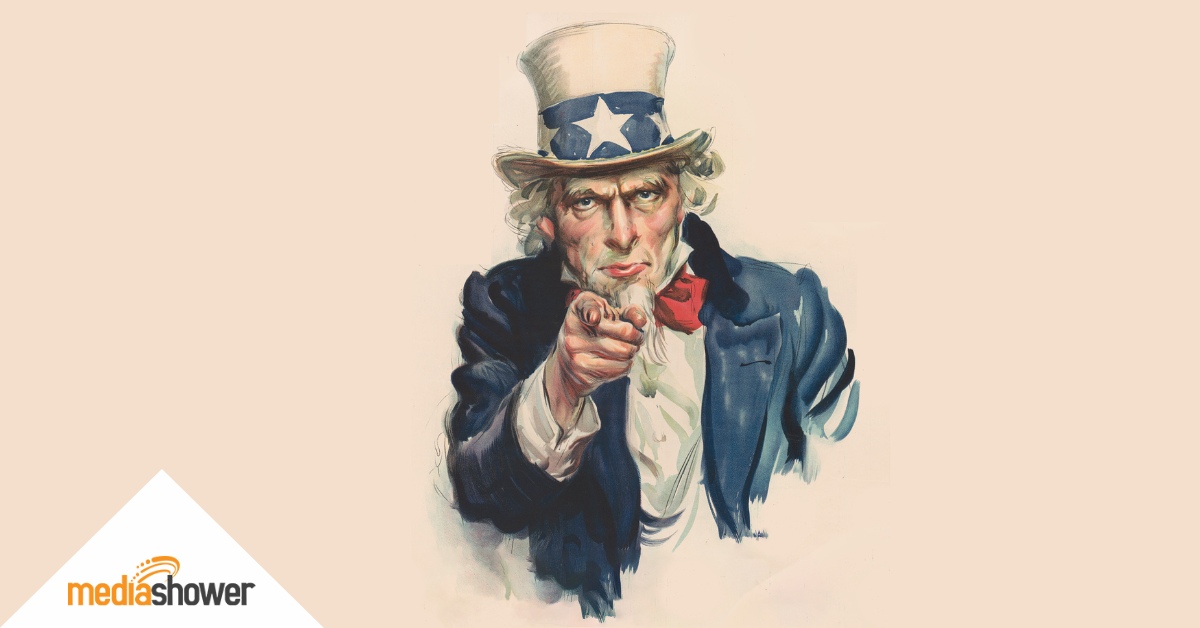
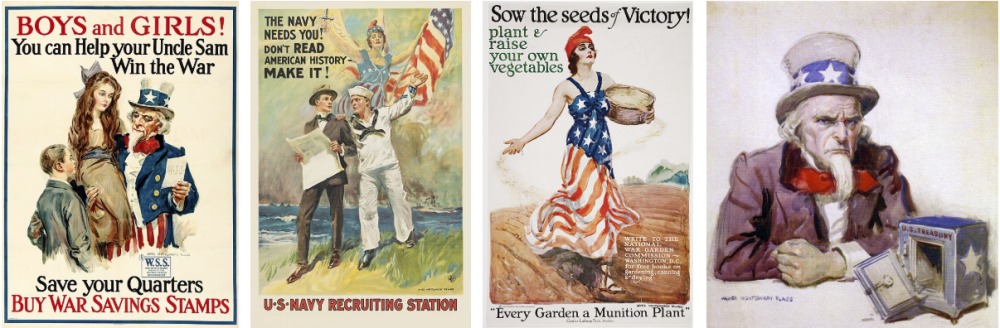
In 1917, artist James Montgomery Flagg painted himself as Uncle Sam, adding age, a goatee, and a white hat, for a poster printed over four million times before the war ended. The design proved so effective it was revived for World War II without a single change.
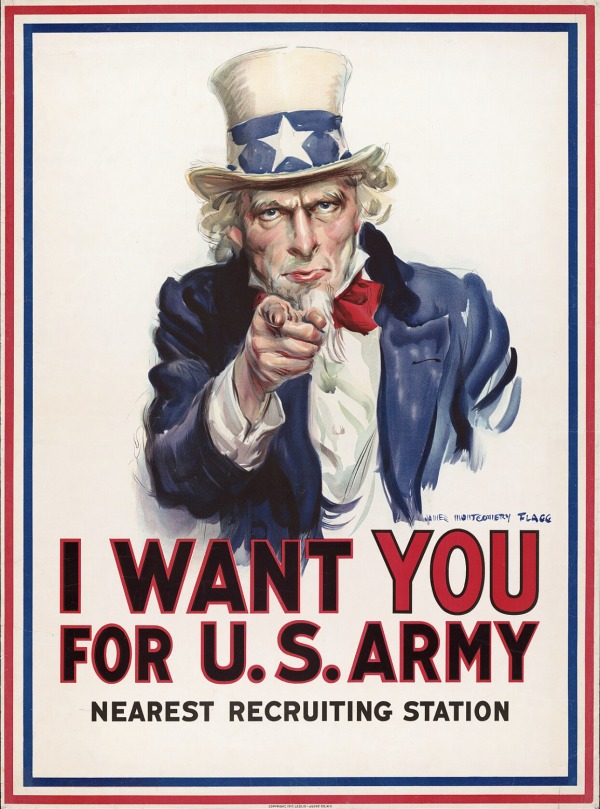
The genius of “I Want YOU” was its direct address. Uncle Sam doesn’t speak to “Americans” or “patriots.” He points at the viewer and says you.
Every direct-response marketer working today, every personalized email subject line, every ad engineered to make the viewer feel singled out, is running that same play.
The first government creative agency
The poster came out of the Committee on Public Information, essentially the first government creative agency (or propaganda machine, depending on your point of view).
They ran pamphlets, deployed trained speakers in movie theaters during reel changes, and segmented their messaging by geography and audience.
Content marketing, influencer deployment, and targeted distribution, all in 1917, before any of those terms existed.
The War Bonds Campaign (1942–1945)
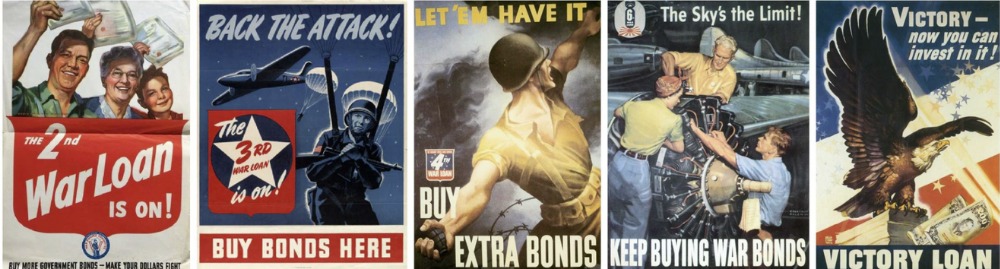
World War II brought a different challenge. To fund the war, the government needed ordinary Americans to hand over real money in exchange for bonds with below-market returns. Patriotism was the pitch.
The mechanism they built to deliver it at scale introduced a model that consumer marketing has been copying ever since.
The ad industry’s first pro bono campaign
The War Advertising Council mobilized New York’s top agencies in 1942, producing campaigns including “Buy War Bonds” and “Loose Lips Sink Ships,” all without compensation.
The entire apparatus of cause-based public service advertising was invented here, and it still runs today under the Ad Council’s name.
After just one month of the bonds campaign, 90% of Americans in national polling were aware of war bonds. Most product launches today celebrate a 10% awareness lift.
Celebrity endorsement
The government understood celebrity credibility as a conversion tool long before brands caught on. The “Stars Over America” campaign deployed 337 celebrities across more than 300 cities to raise $838 million in bonds.
The mechanics were deliberate and specific:
- Bette Davis traveled the country as one of the campaign’s most visible faces.
- Hedy Lamarr auctioned kisses for bond purchases.
- Betty Grable auctioned her nylon stockings.
- Jack Benny auctioned his violin.
Even the president participated. FDR’s purchase of the first war bond was broadcast live on national radio and distributed as newsreel footage to movie theaters across the country.
These were engineered emotional events, designed to make financial participation feel personal, urgent, and socially rewarding.
Over the course of the war, 85 million Americans purchased bonds worth more than $180 billion, roughly $4 trillion in today’s dollars.
Every athlete endorsement deal and influencer product drop since traces its DNA back to the Treasury Department’s wartime playbook.
The government had proven that star power converts, but celebrity appearances in bond drives could only reach so many cities. The next leap was putting the uniform on the biggest screen in the world.
The Pentagon’s Content Studio (1986–Present)
The Defense Department has collaborated with Hollywood since the film Wings (1927), but the sharpest case study is Top Gun (1986).
The Navy had a serious brand problem: Vietnam had dismantled two decades of goodwill, and a generation of potential recruits had grown up watching the uniform get mocked in popular culture.
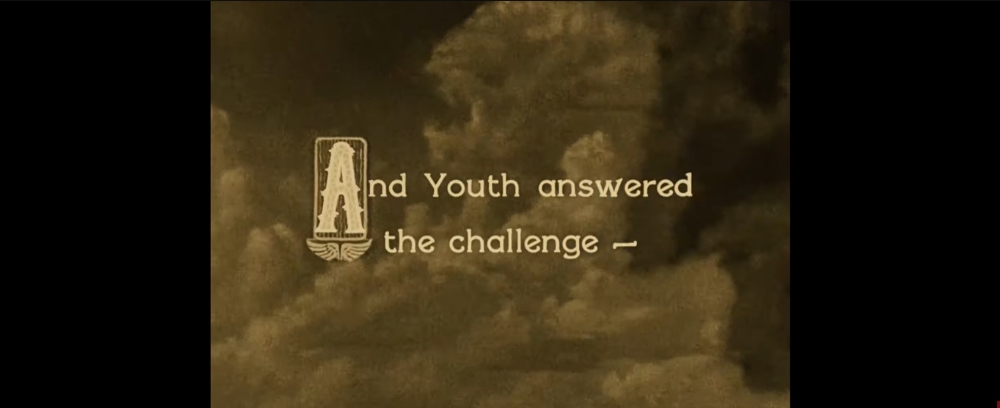
Internal Pentagon documents put it plainly: Top Gun was made solely to rehabilitate the military’s image, “which had been savaged by the Vietnam War.”
The Top Gun strategy introduced branded entertainment at the largest possible scale. The military produced content so compelling that the audience came voluntarily, then placed recruiters at the exits — literally.
Commander Ronald Flanders, spokesperson for U.S. Naval Air Forces, noted years later that many of the Navy’s current senior captains and admirals trace their interest in naval aviation directly to that film.
The Air Force ran the same play with Captain Marvel in 2019 and recorded its highest number of female applicants in five years immediately after the film opened.
Controlling the content worked beautifully when the Pentagon held the camera. The harder problem was what happened when they didn’t.
“The DoD manages its screen image so carefully, some have suggested it is in effect an unnamed co-producer on thousands of movies, to the extent that Hollywood is operating as its propaganda machine.” – The Guardian
Controlling the Narrative: From Vietnam to Iraq
Vietnam handed the Pentagon its most consequential marketing lesson.
Journalists had broad, largely unsupervised access to the front, and what appeared on the evening news — body bags, civilian casualties, accounts that sharply contradicted official briefings — eroded public support in direct proportion to the coverage.
By the early 1970s, approval ratings had collapsed and recruitment was in crisis.
The lesson was clear: when journalists showed the reality of war, public support fell with it. From that point on, the objective wasn’t just to win the war, but to control the story Americans saw.
The Gulf War product demo
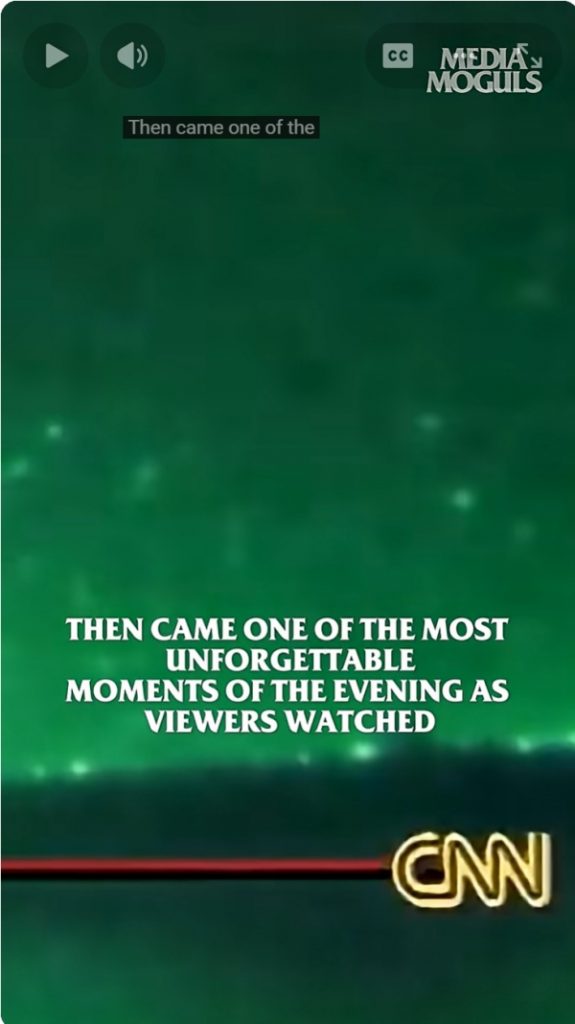
For Operation Desert Storm in 1991, the Pentagon arrived with a new visual language. For the first time in any war, they released gun-camera footage of laser-guided munitions finding their targets: a missile threading a doorway, a bridge span disappearing.
Viewers were transfixed by glowing, green-hued lights zooming and exploding across their television screens, like something out of an early video game. The footage was real. It was also a highlight reel, and the Pentagon controlled which clips reached the networks.
What aired worldwide told one story: American military technology was clean, precise, and overwhelming.
Pentagon officials coined the term “the CNN effect” to describe the impact of 24-hour real-time news coverage on U.S. foreign policy, and they learned to use CNN as a strategic asset, understanding that Iraqi military leaders were watching the same broadcasts.
It was a product demonstration, and it ran on every channel simultaneously.
Embedded journalism: access as narrative design
By 2003, the approach had grown considerably more sophisticated. The blunt press pool restrictions of the Gulf War had frustrated journalists and drawn criticism. The Pentagon’s solution was to give reporters more access, but carefully designed.
Nearly 600 journalists traveled embedded with U.S. and coalition forces, sleeping in the same tents, eating the same food, and coming under the same fire.
Proximity creates loyalty: it’s simple human psychology. A reporter who has shared real danger with a unit covers them differently than one who parachuted in from a hotel across the city.
A RAND Corporation study concluded the program succeeded for the military, the media, and the public alike.
It was the difference between a customer who has built their entire workflow around your product and a reviewer who tried it for a week: same product, completely different story.
“Be All That You Can Be” Campaign (1980–2001)
In 1980, coming off a decade of uninspiring slogans and the long shadow of Vietnam, the Army needed a genuine reset.
Copywriter Earl Carter at N.W. Ayer delivered one of the most durable taglines in advertising history, and he built it on a single insight: sell who the recruit could become, not what the Army offers.
The campaign launched with a jingle written by Jake Holmes that rang out in early TV commercials as “Be All That You Can Be: find your future, in the Army.”
Over time, the official tagline was shorteend to “Be All You Can Be,” the version the Army branded, trademarked, and carried for over 20 years.
Advertising Age named it one of the top campaigns of the 20th century. The Army produced country, disco, and marching band versions and pushed them into high schools and colleges across the country.
The campaign worked because it sold self-actualization. Joining the Army meant becoming a better version of yourself, one who happened to be wearing Army green.
Nike built their entire brand on the same insight with “Just Do It” in 1988, eight years later. Both campaigns sold aspiration first and everything else second.
When the Army revived the tagline in 2023, Secretary of the Army Christine Wormuth confirmed it had been put through rigorous market research against every current alternative and “resonated by far the best with audiences of all ages.”
The Army had cracked identity positioning decades before consumer brands figured it out. Next, they set out to do the same thing with an entirely new medium.
Propaganda: The Game (2002–Present)
In 2002, with Army recruitment at a low point, Lieutenant Colonel Casey Wardynski proposed something no government institution had tried: meet young people where they actually spent their time, and give them real value before asking for anything.
America’s Army launched on July 4, 2002, as a free first-person shooter designed to let Americans virtually explore military life at their own pace. It cost $7.5 million to develop and was free to download and play.
A 2008 MIT study found the game had more impact on Army recruits than all other Army advertising combined.
The numbers were hard to argue with:
- 30% of Americans aged 16 to 24 held a more positive impression of the Army after playing.
- Between 20% and 40% of new Army recruits had played the game before enlisting.
- 20% of entering cadets at West Point had played it.
The game was so successful that the Army has upgraded it several times over the years. The final release was in 2022.
Every brand that has since launched a free app, a useful newsletter, a podcast, or a tool designed to build audience is running the same play the Army ran in 2002, a full decade before “content marketing” appeared in anyone’s pitch deck.
The Modern Era
The military rapidly adapts to new digital platforms. The content marketing doesn’t change; only the channels do.
For example, the Army launched an esports team in 2018, putting uniformed soldiers in front of gaming audiences on Twitch as competitors, not advertisers. The Navy, National Guard, and Air Force followed with their own streaming operations.
Through the early 2020s, each branch developed TikTok formats built natively for the platform: short-form day-in-the-life videos, behind-the-scenes training content, humor-forward posts designed to travel organically.
The production values are deliberately rough, because polished advertising signals advertising. Native content signals belonging, which is what military recruiting has always been selling.
just having a good time with the US Army esports twitch stream @JordanUhl pic.twitter.com/qnjyxg1KP0
— Rod Breslau (@Slasher) July 8, 2020
By 2025, the Pentagon was posting strike footage directly to social media. The content was so cinematic, so visually identical to first-person shooter gameplay, that audiences couldn’t reliably distinguish it from Call of Duty clips.
The process bypassed the traditional press pool and intermediary journalists. The shaping had moved from controlling which reporters saw which things to controlling the visual language itself, so the audience arrives already inside the Pentagon’s framing.
From 1917 to 2026, all of these tactics have a common thread: The content comes first. The ask comes second.
That sequence, which every content marketer today treats as a modern insight, has been the military’s operating system for over a century, proving that Madison Avenue didn’t invent content marketing.
They inherited it.
Marketer Takeaways
- Speak to one person. Direct address drives response, and every high-converting ad and email since 1917 has been running that same insight.
- Sell the identity, not the product. Aspirational positioning outlasts any feature claim and compounds over time in ways that product benefits rarely do.
- Design the experience your audience covers. When you can’t stop people from forming opinions about your brand, shape what they’re exposed to with onboarding, community, and access.
- Build content people actually want. Like America’s Army, your content is only useful to you, it’s an ad. If it’s useful to your audience, it’s a product.
- Use celebrity to amplify what’s already resonant. Celebrity works when it reinforces an idea the audience already wants to believe.
Media Shower’s AI marketing platform helps your content be all it can be. Click here for a free trial.